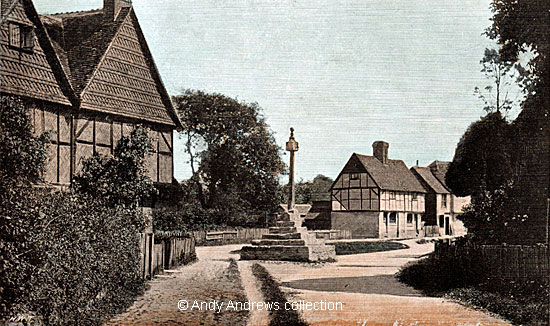
In 1911 a local paper noted that "East Hagbourne's ... greatest possession is a restored step-cross.
Very few of these step-crosses exist in this neighbourhood, but formerly they added much to the picturesqueness
of our villages[1]". The cross at East Hagbourne is in the centre of the village,
to the north east of the parish church.
A photograph of the cross, dating from 1871, was published in the book "Around Didcot" and shows the base
was then in a poor state of repair[2]. Whilst it is unclear when the ancient
cross was restored, there are numerous photographs, paintings and postcards from the first decade of the 20th century
that show restoration work had been carried out, probably at the end of the nineteenth century. The early 20th century
postcard, above, shows stones had been replaced on the square base and the whole had been re-pointed.
There are five deep steps, with a tall shaft which has "on one side, at the foot, a wide deep niche, and
above it a smaller one, with traces of a canopy; it is now surmounted by a cubical sun dial. The stone cube has
(17th c) "sun-dials on three sides, and on the fourth an inscription illegible from below[3]".
At the top is a stone ball finial. We know that the Earl of Essex and the Parliamentary army were here in 1644,
and it has been suggested in various sources that damage was done to the cross at that time, but despite searching,
I have found no evidence for this to date.
Today it is classified as an ancient monument[4].
The three 17th century timber framed Church Close cottages on the left of top picture are partly jettied and the
bricks, in herringbone pattern are between the timbers. The property on the right of the close, in the photograph below,
has similar brick infill (nogging).
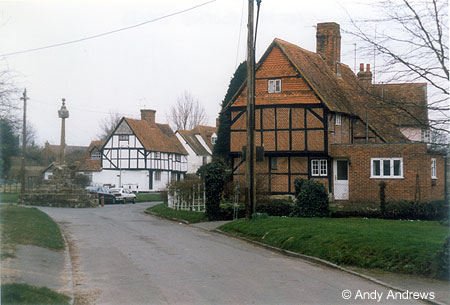
The cross viewed from the church.
The author of Berkshire's "Highways and Byeways" observed that by 1919 "East Hagbourne
has been discovered by artists of real merit, who may be relied on to "boom" a district effectually,
in inverse ratio to their desire to do anything of the kind ...[5]."
However, artists had begun painting here over a decade earlier. Alfred Parsons, A.R.A. exhibited a painting of
the cross, with pigeons at its base, in oils "in which the pearly greys are used with peculiar softness[6]",
in 1908. Another artist, Mr Robert Anning Bell (1863-1933), lived at Upper Cross. In 1914 he was elected an Associate
of the Royal Academy. He was a Professor of Design at the Glasgow School of Art, as well as a stained glass designer,
a painter modeller and illustrator[7].
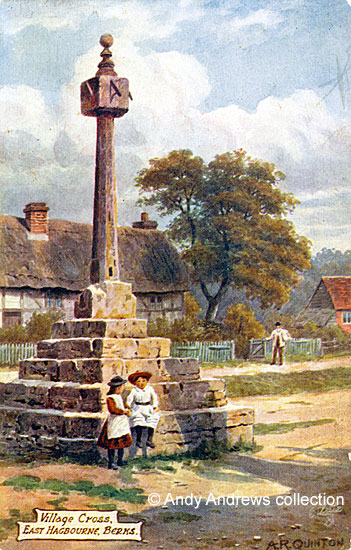
A. R. Quinton's painting of the Cross, which was turned into the postcard above, ca. 1905.
The three sundials at the top are much clearer on this view.
The publishers wrote the following on back of the card:
East Hagbourne is perhaps the most imposing of the village crosses
to be found in Berkshire. The base is formed of six tiers of masonry, and
the sundial at the top of the shaft, which has probably replaced the original
crucifix, gives a pleasing finish to the stucture.
Quinton painted at least two more pictures of the Cross in his travels around the
countryside on his bicycle. A book of his work, "The Rural England of A.
R. Quinton" was later published by Salmon[8].
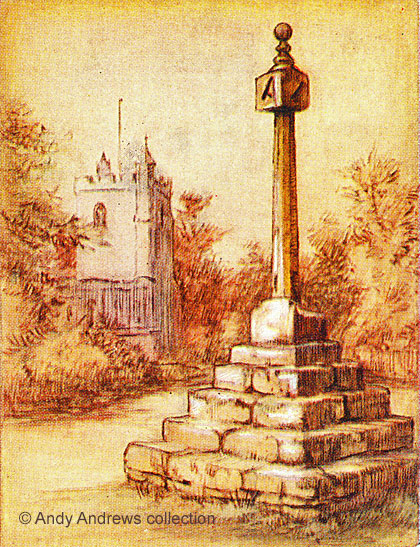
1928 cigarette card, one of a series of sundials the company published.
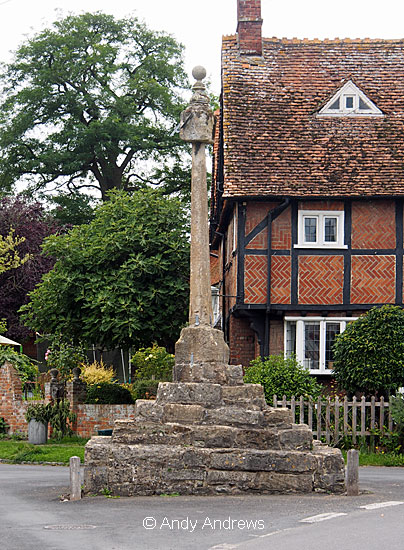
Upper Cross, East Hagbourne.
It was re-pointed and repaired again in the 1980s.
Notice the posts at each corner of the base, that have been in situ for some years,
to prevent damage to the base.
There is more onsite information:
 Our Genealogy Our Genealogy
Or visit the GENUKI site:
What's
in a name - The Surname Andrews (opens in a new window) |