| |
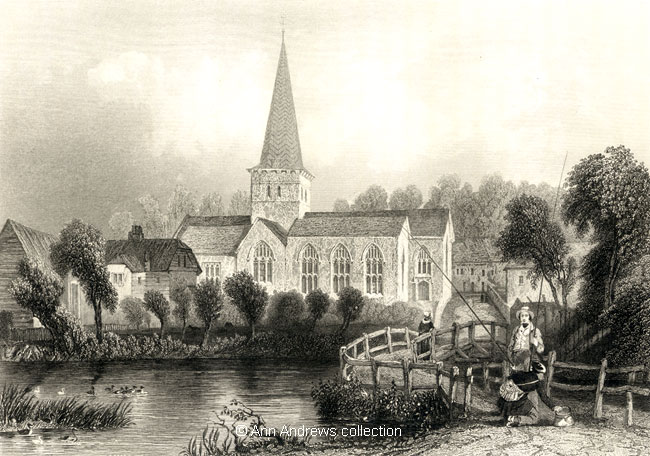
| Godalming : Engraving of SS. Peter & Paul Parish Church, 1840 |
|
Godalming Church
(1840)
Drawn by T. Allom.
Engraved by J. H. Kernot.
|
|
A vestry meeting was held by the churchwardens on 3 October 1838 to discuss repairs to the parish church. They set a new church rate and
a committee was appointed to help with repairs to the steeple although during the following month the town's surveyor reported on
the matter and it was decided the steeple repairs were not necessary. At a subsequent meeting on 17 April 1839 improvements were
discussed and the next month a faculty was applied for so improvements could be carried out[1].
The vicar at the time was John Garwood Bull, who had been instituted on 29 June 1838[2].
In early 1840 the Godalming's population was more than 5000, yet the church sittings for adults and children were only 879 and the
following was reported in Kent newspaper:[3].
"More that two thirds of the respectable inhabitants, have by their sign manual, certified that they have never been
able hitherto to obtain any accommodation for themselves and families. For the poor there are only 108 sittings, —for children, 213.
It is proposed to add 1042 additional sittings at least to the present accommodation, making altogether 1881, of which 1150 will be free.
I. By rebuilding and extending the North Aisle.
II. By extending the Nave to the West.
III. By remodelling and enlarging the South and West Galleries.
IV. By building two additional galleries in the North and South Transepts.
V. By repewing the whole ground floor.
The estimated cost of the needful alterations is about £2578. Of this sum £2000 has already been subscribed : among the contributors
to which, we observe the incorporated Society for Building Churches £500 ; the Diocesan Church Building Society, £400 ; Bishop of
Winchester £20 ; Viscount Middleton £20 ; Miss Wood £100 ; the Dean of Sarum £25, &c. &c. With such examples
before the public, there can be no difficulty, we should imagine, in collecting the remaining £578".[3]
This article was partly a notice about what was intended and partly a comment about why something needed to be done urgently.
Welman suggests that more work must have been undertaken than was first agreed on. The nave was lengthened for the second time; both aisles
were made lofty, with span roofs ; the north chantry was rebuilt and used as a vestry. Large perpendicular windows were provided for the
nave and aisles, and the church was regalleried and reseated. The exterior was stuccoed, something that had probably been done before. He
was also probably not alone in thinking that this renovation was unsatisfactory. He provided two main reasons he thought were ."unpardonably
wicked." The first was to remove the very old sancte or sanctus bell (see Nightingale Cemetery,
Deanery Road, where this bell was hung for many years) and the second was to cut away and replace the nave's Tudor ceiling, putting in tie
rods at the same time.
Unfortunately, "the work of 1879 was necessarily largely an undoing of the work of 1840, and a rebuilding, still larger, of the north
and south aisles of the church, with an extension of the north transept for the purpose."[3].
The engraving above shows the church after the 1840 alterations, together with what is today part of Borough Road. The former rectory is on
the right and the two storey terrace of houses of Deanery Place opposite the church can be seen on Church Street. In his book about the town
John Janaway includes an excellent photograph of almost the same view, taken in the 1860s. The large building on the left was Castilion House,
which he says was demolished before 1865. It had been tenanted by Mr. Baptist[e] Castilion in the reign of Elizabeth I and replaced an earlier
building of "some considerable substance". The Phillips Memorial was erected on the site in 1914[4].
A series of letters written in the 1570s mention the church and two of its vicars, one of whom was about to be deprived of his vicarage in 1574.
In 1578 Mr. Baptist Castilion wrote to Sir William More about the presentation of Mr. Francis Taylor to the living and then two days later
sending another about Taylor not being not resident "for lak of a howse" and on the 28th November about the vicar's right to
the parsonage house, which he claimed as his own property[5].
In 1914 the Phillips Memorial Cloister was erected on the site once occupied Castilion House.
Related pages
|
Images:
1. "Godalming Church". First published in Brayley, E. W., "A Topographical History of Surrey"
and later reprinted by Virtue & Co in 1878, when Kernot's name was replaced by that of Virtue. The plate was first
published in 1840, as shown above and the details provided below the image are reproduced from my print.
Engraving in the collection of, provided by and © Ann Andrews
Intended for personal use only
|
References:
[1] Welman, Samuel (1900) "The Parish and Church of Godalming". Published by Elliot Stock.
[2] "A Topographical History of Surrey", Edward Wedlake Brayley & John
Britton (1844). ... The Illustrative Department under the superintendence of Thomas Allom, M. I. B. A. Published Dorking
by Robert Best Ede and London by David Bogue, Fleet Street.
[3] "Kentish Mercury and Greenwich and Surrey Gazette", 8 February, 1840.
[Surrey section] Godalming. Enlargement of Godalming Church.
[4] Janaway, John "The Story of Godalming" (1983) Local Heritage Books, Newbury
ISBN 1 86368005 4.
[5] "West Surrey Times and Guildford Gazette", 22 September 1883 and 29 September
1883. Local Notes and Queries. Miscellaneous Extracts from the Loseley Manuscripts Relating to Godalming Neighbourhood, Continued.
—April 4, Edward VI, to 23 Sept. 9 Eliz. Vellum Roll. Several letters relating to the vicar of Godalming, including from the
Bishop of Winchester and Mr. More at Loseley and between Mr. Baptiste Castilion and Sir Wylliam More, knt.
|
|
|