|
Guides Index> All About Derbyshire> This page |


| All About Derbyshire by Edward Bradbury, 1884 (7).* |
| Eighteenth and nineteenth century tour guides about Matlock Bath and Matlock |
Railway Readings. Chapter XXIV OVER THE HIGH PEAK RAILWAY, pp. 254 - 265 |

|
|||||||||
 "No poetry in railways! foolish thought Of a dull brain to no fine music wrought." MACKAY. |
||||||||||
Most tourists in Derbyshire have, I take it, encountered, at some point or another, the acute curves, and sensational gradients of the Cromford and High Peak Railway, and have wondered what the mysterious trackway was, how it got there, from whence it started, at to whither it was directed, and were glad to think that their route did not include the adventure of those Avernus-like declines and those sharp bends. For the information of these good ladies and gentlemen, the present paper should be prefaced by the remark that the High Peak Railway is purely used for goods and mineral traffic, and that passengers are not conveyed by it, although some years ago the guard was allowed to take a few people between local stations, but an accident occurred which closed the privilege. Thirty-two-and-a-half miles long, this mountain line connects the Cromford Canal and the Midland Railway at Whatstandwell, in Derbyshire, with the Peak Forest Canal and the London and North Western system at Whaley Bridge, Cheshire. It was constructed at a cost of £200,000 as a private enterprise and the line was leased eventually to the London and North-Western Company in perpetuity. This morning I am to traverse the whole extent of the line on the engine, or rather engines, for the railway is divided for working purposes into eight sections, viz. : — High Peak Junction to Cromford ; Summit of Sheep Pasture to Foot of Middleton ; Summit of Middleton to Foot of Hopton ; Summit of Hurdlow to Hurdlow ; Hurdlow to Harpur Hill ; Harpur Hill to Grin Branch Junction ; Colliery Junction to Bunsall ; and Foot of Bunsall to Summit of Shallcross. Some of these names will sound strange to the ear of even the reader who prides himself on his close acquaintance with the Peak district. Off the beaten track they are like hamlets that have got lost among the hills, and need a special exploring party to discover them. The High Peak Railway, it may be further advanced in the way of preface, is a single line. It is of the same width of gauge, and of the same character of permanent way, as the lines belonging to the London and North-Western Company's ordinary branches. Like all single lines, the traffic is worked by what in railway parlance is known as the " staff system." The staff is a truncheon painted and lettered specially for the division of line over which it acts as the open sesame. It is suspended on the weather-board of the engine, and no train or engine may enter any section without being in possession of the engine-staff belonging to that section. The driver cannot start without this staff, which he receives from the official in charge of the staff station ; and on arriving at the station to which the staff extends, the talisman is given up to the person conducting that place. Through or local, "up" or "down," "fly" or "slow," there are twenty-two trains a day on the High Peak Railway, and the fastest trains occupy a space of over five hours in performing the entire journey. All this I candidly concede, my dear Madam, is very dry and uninteresting, and I apologize for being so tediously technical. The only extenuation I can urge is that the High Peak Railway is in itself a solid fact of such dimensions that a discursive description of it should also be "ballasted " with facts and figures, data and detail, to carry even my special light locomotive safely. I am at Whaley Bridge this July morning ; and before half the world has breakfasted, and while housemaids, drowsy and slovenly, are yawningly lighting the fire to prepare the matutinal meal, the through "up" train to Whatstandwell is off and away. Due out at ten minutes past seven o'clock, we are timed to arrive at the Cromford terminus at a quarter past twelve, according to the current time-table, which is dated "December, 1876, and until further notice ;" an arrangement which is primitive and simple, and makes one wish that the hours of departure and arrival of all trains in "Bradshaw" savoured equally of the unvarying constancy of the Medes and Persians. One leaves Whaley Bridge, with its factories and colliery gins and slag heaps, without regret. The first mile or so of the ride is achieved in the guard’s brake, and is up the Shallcross gradient, a straight rise of 1 in 8½. The line is here double, and is worked by an endless chain. Presently we are among the bold features of the Derbyshire moorland hills; and the Goyt on our right is running innocently away between the banks of lichened rock, coy fern, and hanging trees. A locomotive meets us at the summit of the incline, and working tender first, is taking on our train of some twenty waggons ; a cargo which is a curious olla podrida of grains, barrels of beer, bags of beans, sewing machines, flour, lime, coal, cans of paint, boxes of tea, and agricultural implements. To one accustomed to the swift, smooth, motionless motion of a Pullman palace car, or a Midland bogie carriage, the jerking, jolting, jig-dancing of the engine of the High Peak Railway is an experience to remember as a certain specific for the cure of indigestion. The seven o'clock breakfast is already shaken down; and no wonder that Toodles, the stoker, is feeding himself as well as the engine. Toodles is a grotesque combination of grit and grease, and might have been carved out of a column of coal and then roughly oiled and toned down; while his "mate," the driver, an older man, is suggestive of an impossible partnership between a butcher and a chimney sweep, wearing —as he does —the blue blouse of the one, and the mosaic of soot of the other. We are now in full swing; and everything about the train strikes me as being mechanically malevolent, discordant, and out of temper. The engine has not the mellow "fluff, fluff," and the full-voiced, deep-throated "chay-chay," of its superior locomotive brethren, the race horses of the main line. It spits its way along spitefully, and starts with a jerk, and stops with a jump, and goes with an irregular lurch throughout that is trying to one who has not acquired his "sea-legs." The waggons, through not being so closely united in the tightness of "coupling" as they might be, batter away at each other as if each individual truck had quarrelled with its partner, and was settling its grievances in blows. The curves are so sharp and frequent that ever and anon the train seems intent on the study of Euclid’s Elements, and describes every denomination of geometrical outline, the favourite one being an acute crescent, when the van at the rear of the train comes up at angles with the engine just to allow the driver and guard to shake hands, and show that if the engine is ill-tempered, and the waggons are emphatic in their contempt for each other they, at least, are friends. Now the whole train seems bent on going a trip over the low stone walls into the neighbouring moors to the right; then it evinces that it has changed its mind and as a disposition for toppling over to the left. Between walls of woodbine and ivy now; then to the right, the deep wooded shade of Errwood Hall, as the line runs along a terrace of rock, high over the wild, green, glen beauty of the Goyt Valley. Presently Bunsall is reached, Here the engine leaves us, and the train is pulled in instalments up the steepest gradient of the line, varying from one in seven to one in eight. It is a double one, the first straight, the second on the curve. The operation is a long and tedious one ; but at last the whole train is marshalled on the summit. Another locomotive is waiting to take us on, and I am making friends with the two fresh engine men, greasier and grittier than the last, and am learning to balance myself on another quivering foot-board, as we pant through a wild, bleak, hilly country. We seem to be moving along the top of the world; there are deep hollows in the hills below ; and every variety of peak and rounded knoll. The journey is a scamper across savage and solitary moors. The heather grows to the verge of the line. The rarefied air blows about you like a fresh sea breeze. The train is the only moving thing in sight, save when a wild grouse, or a curlew, rises with a sharp startled cry. Then, just as Buxton is seen, with its white houses lying in the hollow, and shining like a pearl in a setting of emerald, a sudden scream from the engine takes the startled air and darkness shrouds the speeding train, "Burbage Tunnel," yells Toodles in my ear, as he opens the firebox, and stands like a Salamander in a white dazzling circle of heat. But the wind has hurried away with his words. A thousand echoes are fighting with each other; the wet walls fly past like a rushing river; there is a furious whirlwind of tumult, and a damp chill that might belong to the Styx. The train, indeed, might be Charon’s boat; and the driver, Standing so statuesque and silent in the broad, blinding circle of white light, with his eye strained in earnest watchfulness, and his hand fixed with decisive hold on the cold glistening regulator, might be Dante’s infernal ferryman. In the distance, however, there is hope. A glimpse of light, looking as big as half-a-crown, widens. It grows larger and larger, until, with a wild shriek of exultation from the snorting engine, we emerge from the confined vault, with its darkness and damp, and strange unearthly noises, into the glad blue light and freedom again, and see the windows of Buxton flashing back the sunlight far away below our breezy tableland. Half-a-mile long, the Burbage tunnel is the only one on the High Peak Railway of any importance, and it is dirty enough and wet enough for them all. This is "Ladmanlow," ventures the driver, shutting off the steam. The information anticipates my query, for there are no name-boards on any of the stations to indicate your whereabouts. The stations, indeed, are but sheds ; and they sometimes seem to be the only erections within miles of anywhere. Some little time is now occupied in the operation known as "shunting," the dropping of one waggon off, and the coupling of another on ; sending this truck down that siding, and fetching that truck from another. After thus playing at a species of truck-tennis with the entire train for some time, we rattle along again. Past Diamond Hill ; past the stony slopes of Solomon’s Temple; past Harpur Hill, with the tall, insolent, ugly, ubiquitous chimney which threatens the vision of the Buxton visitor wherever he may be, whether on the top of Corbar, or on the slopes of Axe Edge, or at the Cat and Fiddle, or at Fairfield. And now the landmarks are lost, and we are running with a rattle and roar over the moors. Steep are the gradients, and "a caution" are the curves. The engineman treats his iron-horse as if he were driving a living animal. He knows her faults and her good points. He can tell at what part of the road she wants whip and loose rein, and when he must hold her in with tight hand. And the iron Bucephalus responds as if sensitive to his will, and the slightest movement of the regulator is as a touch of spur, and makes her spring on like a creature of blood and nerves. Now a hare starts by the side of the line ; now some grouse rise with noisy "cluck-cluck ;" again, a flight of crows, making for some feeding place, is the only sign of life in the lofty loneliness. Here there are fields on either side of the rough track ; but what the unsophisticated eye takes for sheep grazing are really so many obtruding blocks of gray limestone. Hindlow is the next stopping place. "Low" in the Peak district mean "high ;" and the quaint old Derbyshire people describe residence in these exposed altitudes as "living out of doors" Hurdlow is the succeeding station ("low" again, you see) and this is the highest point of the High Peak Line. To get here there was formerly a third incline, but the gradient has been rendered workable by locomotive. A change of guard, and transfer to a third engine, with driver and fire-man who can hold their own in grease and grit with their ebony colleagues. There is no water supply at this depôt, and to assuage the Iron Horse’s thirst, water is brought in large tanks from Ladmanlow. More truck tennis ; and then we bump along again; now upon a terrace of rocky embankment; now in a steep cutting, with the naked limestone rocks clothed in flounces of green which you can gather as you pass, so scanty is the clearing ; now a sharp whistle of warning from the engine to announce our approach to some platelayers, who leap aside with pick and shovel just in time as we whisk past in a cloud of steam. Anon we rush under a bridge carrying a road that seems to lead nowhere ; then we pause at a little one-horse kind of a station called Parsley Hay, which looks just like a wayside shed on an American prairie line. The guard seems to combine the duties of station-master, shunter, clerk, signalman, porter, and inspector. Indeed, he seems to be the only element of existence about the place. One misses that pleasant aspect of life, that intensely human interest, which belongs to English country-side stations. There is an omission of healthy, unkempt children to see the train pass through. Nobody gets in or out. Where is the stout old lady who is always so anxious about her luggage ; three boxes, a portmanteau and a basket, all with a bit of red flannel tied to the handles. And where is the crimson apoplectic person, with umbrella and carpet-bag, who rushes up to the train just in time to behold it pass away without him? There are none of those little lyrics, those charming pastorals and delicious idylls, one can always observe on village platforms; where lovers meet lovers, and friends say the sad word farewell ; where there are kisses at the carriage doors as honeyed as Eros sucked from the lips of Psyche, and tears as scalding as those which dimmed the eyes of Eurydice when Orpheus was snatched from her side. There is not even the stumpy church tower to be seen mixed up in trees, and rising above gray old gabled farm-buildings, at these High Peak out-of- the-world stations. Between Friden and Minninglow is the great Gotham Curve, which describes a rectangular square ; and then — quick, if you please ! — and you will see, on the left hand, the Arbor Low rocks ; hoary Druidical stones. And then, after this glory of the rocks, Toodles screws on his brake, and we stop at Bloore’s Siding. Who is Bloore that he should have a siding? He is evidently a man of bricks. But the subject is not one that is likely to throw the world into convulsions of controversy ; and the engine is panting away again. The scenery, truth to tell, has not been specially attractive during the last few miles. There have been none of those poetic vignettes of green valley and gray crag, gleaming water and glowing wood, that make the ride in a Midland carriage from Derby to Marple such a rich railway romance. Rather a monotonous table-land, where niggard fields and stubborn heath are ruled off with bleak stone walls, and the perspective is unbroken save here and there by a clump of storm-rent ragged pines. At Longcliffe, however, the views are more diversified; and we get in a pleasant country of hill and dale, with glimpses of wood and water, rendered all the more pleasing to the artistic eye by the sudden lighting up of the picture by the sun, which has been sulking behind gray clouds all day. As Hopton is approached there is some bold rock scenery ; and the limetone cuttings show engineering works of great difficulty. Another engine is harnessed to ours here, and with both brakes screwed down, we slide down the incline to Middleton. To think that I have for a moment allowed myself to charge the High Peak Railway with being unpicturesque ! Peccavi, as the droll commander said when he announced to the First Lord his capture of Scinde, contrary to instructions. Picturesque enough to make me wish to enchant hither the painters by whom it would be most appreciated is the view now, with the Black Rocks of Stonnis, pointing over the Matlock Valley, and Barrel Edge rising in serried ranks of pine and fir above them, and the filmy smoke of peaceful Wirksworth rising lazily from the green-wooded hollow beyond. That Sleepy Hollow is Adam Bede’s country; and in the churchyard yonder Dinah Morris awaits the Resurrection bidding. Do you recognize the scene from "the preaching" chapter of George Eliot’s first, freshest, and most famous work? But there is something else to think about besides George Eliot now, oh dreamer. There is the Middleton Incline to go down. The locomotive leaves us; and down below drops the shining track of steel, its diminishing lines a study of perspective. The gradient is 1 in 8 ½ ; and the train let down two waggons at a time by a coiled wire rope from a stationary engine. You must be quite prepared to hazard the risk of the run down. Sometimes a waggon does break loose, and it will not stop to be reasoned with, but goes to swift destruction. Ride across the buffer, my friend, and be prepared to jump off at once if anything gives way. The hook is coupled to the waggons. Off we glide. The cab swings and clangs ominously as it strikes the steel roller which seem to say "Caution!" in a metallic voice that keeps repeating itself all the way down. Steeplehouse is the next station; and here the view of the line is beheld as, riding on yet another locomotive, we pass directly under the Black Rocks and see through the green veil of the sunlit wood that vision of Matlock, with the deep crags of the Derwent valley, which is like a piece of sublime theatre scene-painting from a romantic opera. There is another of those creepy, dithery inclines at Sheep Pasture, with a gradient on the curve of 1 in 8 down to Cromford; but one forgets the risk of riding on buffers, in the green beauty the scene, for the rocky cutting through which the line winds is a fern paradise that is a revelation of loveliness. Another locomotive to take the train to High Peak Junction at Whatstandwell. The unique "Oozly bird" came over to this country, it is well known, in two ships ; but to get over the High Peak Line involves at least half a dozen locomotives. No thank you very much, Toodles. I will not ride down to the Junction. My bones have been sufficiently dissected ; and "The Greyhound" at Cromford is eloquent of a refreshing bath, and of a well cooked dish of plump trout that were rising at flies in the cool Derwent an hour or so ago. 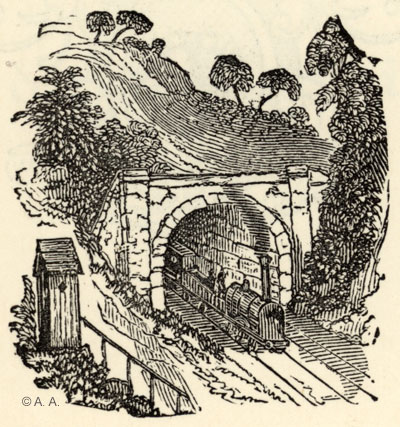 |
||||||||||
|
*Text transcribed by Ann Andrews in November 2025 from her personal copy of the book. Bradbury, Edward (1884) "All about Derbyshire." With sixty illustrations by W. H. J. Boot, J. S. Gresley, W. C. Keene, L. L. Jewitt, G. Bailey, J. A. Warwick, R. Keene, and others. Simpkin Marshall, London : Richard Keene, All Saints', Derby. Images © Copyright Ann Andrews collection. Intended for personal use only. |
||||||||||
Related pages elsewhere on this website:
|



 Scarthin Nick From Allen's Hill, 1892 (shows The Greyhound)