|
Images Index> Matlock Bath, 20th and 21st Century Images> This page |


| Matlock Bath: Sanger's Circus, 1900 |
| Matlock Bath : Twentieth Century Photographs, Postcards, Engravings & Etchings |
|
|
||||||||||||
"Nine-tenths of the population of the United Kingdom have heard their Mothers, Fathers and Grandfathers speak
of, and Millions that now wear their honoured grey hairs, in the sear of life, will say Sanger's Circus was the first
circus I ever saw! Sanger's has been the best circus I have ever seen!! Sanger's always have something new!!!"[1]
Sanger's was one of the biggest English circuses during the 19th century and the self-styled Lord George Sanger, who was the second generation of the circus owners, certainly knew how to hype things up. When he visited Derby in 1897, for example, the advertisement he placed in the local paper read: Lord George Sanger (b.1825) added that the Derby show marked his Diamond Jubilee as a performer, dating his professional life from 1837. He also congratulated Queen Victoria on her own Diamond Jubilee. Sanger's Circus had developed as a family business, begun by Mr. John Sanger who died in 1889[3]. His circus was sometimes billed as a "MONSTRE HIPPODROME AND MENAGERIE. The Mighty Monarch of the Road"! He certainly knew how to grab the attention of his audiences in his advertising. He had been in partnership with his son, George (1825-1911), though this was said to have come to an end before he died. John Sanger's business was taken over by his son[4], and Lord George retired in October 1905[5] but before than he and Lord John Sanger seem to have been travelling the country independently of each other. Sadly, at the age of 84, Lord George was attacked and murdered by an employee at his home in East Finchley in 1911[6]. Lord John Sanger, who was the third generation of the family to run a circus, died in 1929[7]. The first reference of them visiting the Matlocks found to date was in 1886 when "Messrs. Sangers' gigantic establishment [had] entered Matlock Bridge, and 7 large banners and Union Jacks make their appearance upon some of the eminences at the Bath and elsewhere"[8]. They undoubtedly passed through Matlock Bath on that occasion, too. Whilst it is sometimes difficult to know which of the two competing circuses was visiting the area, as in 1886, we know that it was Lord John Sanger's circus who were performing in the Matlocks in 1899. The Good Friday Bank Holiday that year proved to be a really wet day.
On another occasion Sanger's Circus was performing at Bateman's Park, opposite the Railway Hotel, in Matlock[10]. Their elephants were always a popular attraction and on this occasion some of them, according to a book by Mr. Arkle, were seen to drink water from the Derwent. Unfortunately, one of the animals became problematic and refused to leave the river; attempts to scare it - with gunfire - were unsuccessful. A second elephant was taken back into the water to encourage the stubborn animal to come out. Whilst no date was provided for this particular episode, it must have taken place in May 1905 as Arkle also recounted what happened to the animal when the circus moved on to Bakewell (see below)[11]. 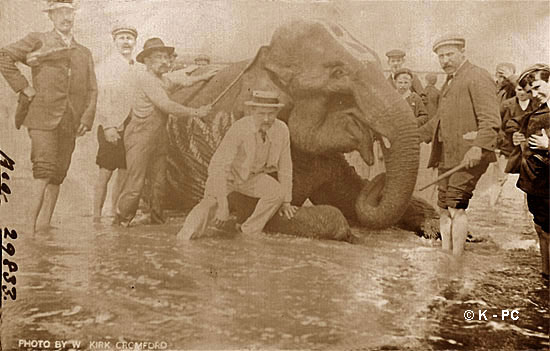 One of Sanger's circus elephants enjoying the attention whilst lying in relatively shallow water in the River Derwent at Matlock. The photo was taken by Mr. Walter Kirk of Cromford in May 1905. The man wearing dungarees and a wide brimmed felt hat on the left was Mr. George Coleman, the elephant's trainer, and the two men wearing flat caps were also circus employees. It is also likely that the man on the left worked for the circus. The man wearing the boater could also have been a showman, but the youngsters surrounding the animals would have been locals.
A second photograph, this time of the deceased animal, was published in the national press without the photographer's permission[13]. One consequence of the "vile display by one of the elephant's at Bakewell" meant that the three remaining animals were given a wide berth when the circus went on to Buxton[14]. Lord John Sanger's circus visited Matlock again on 19 April 1912; it arrived from Belper in the morning before presenting an afternoon and evening performance and was to travel on to Bakewell the following day. It was planned that, should the weather be fine, the first performance "would be preceded by a gorgeous procession of what is best described as a circus, hippodrome and menagerie"[15]. From what can be seen in the rare images here, it seems an apt description. The 1912 show also included "A performance of Reputed excellence and the talk of Two Hemispheres, Sanger's Famous Seal Lions, Marvellous Amphibious Performers. Part Animal and Part Fish." Below is another picture of the circus, this time parading through Alfreton's Cattle Market. It is included here as it shows just how long the parades were. There does not seem to have been a similar photograph taken in the Matlocks. In this image you can see a group of four horses, three of which are riderless and on the fourth is a man wearing armour. There are four large elephants and three or four camels in the foreground, with a line stretching back along the road behind them that includes more horses and people wearing a variety of costumes. The circus seems to have visited Alfreton almost every year between 1890 and 1900, and presumably they also visited the Matlocks with similar frequency. They were back in Alfreton again in 1903[16].  Sanger's Circus Procession through Alfreton's Cattle Market. There is an almost identical photograph that was published in a book about Alfreton. That picture was undoubtedly taken just a few minutes beforehand as it shows the same onlookers. |
|||||||||||||
Images: 1. Original photograph of Sanger's Circus in Matlock Bath. In the collection of and provided by and © Ken Smith. 2. Untitled [Elephant in the River at Matlock], photo by W. Kink Cromford, May 1905. © K - Private Collector. 3. "Sanger's Procession, Alfreton" in the collection of and provided by and © Susan Tomlinson. Top image scanned for this website and information researched, written by and © Ann Andrews. Intended for personal use only. |
|||||||||||||
|
[1] "Derby Mercury", Wednesday, 2 June, 1897. [2] It is just possible that the horse drawn wagons and the performers were wending their way towards Cromford Meadows. However, no evidence has been found of them performing in Cromford so it is just could be that the parade did a U-turn at Cromford, possibly passing through Matlock Bath for a second time, and ending up at the Bateman's Park show ground in Matlock. It does not really seem likely. Only two newspaper reports have been found to date about the circus visiting Matlock & District (see below), but the search is still on-going. [3] "The Derby Mercury", 28 August 1889. Mr. John Sanger died at Ipswich, where he had arrived with his circus a few days before. He had pneumonia, and was aged 70. [4] "Ballmena Observer", 1 December 1911. [5] Lord George's retirement was announced in many newspapers in late October, 1905. The People, 29 October 1905 said all his animals were to be sold. "The Herts Advertiser" of 28 October 1905 advertised a sale of Piebald, Skewbald, Spotted, Cream and White-Born Horses and Ponies, Elephants and Camels, Carriages, Harness, Tents, Seating. and all the paraphernalia of the Great Circus. [6] Reading material has included the Oxford DNB | The Times Digital Archive (The Times, Wednesday, 29 Nov, 1911) | Encyclopaedia Britannica. Neither brother had been knighted; the Lord was just part of the showmanship. [7] "Derby Daily Telegraph" 10 August, 1929. Death of Circus King. Taken ill while on tour. [8] "Derbyshire Times", Saturday 1 May 1886. Good Friday at Matlock, by a Tripper. [9] "Derbyshire Times", 8 April 1899. Easter at Matlock. Good Friday Sorrows. [10] This land was to become the site of the bus station and open air market, and a supermarket was eventually built on the land. [11] Arkle, M. J. (1983) "Tuppence Up, Penny Down", printed by Geo. Hodgkinson (Printers) Ltd. Michael Arkle does not provide a date for his story, but implies that the Circus was in Matlock around the time that Matlock Bridge was widened in 1903/4 or shortly afterwards. He mentioned that the Circus then moved on to Bakewell and the elephant's behaviour worsened. Arkle said it pulled down a tent pole during the performance at Matlock before going on to Bakewell and added that the unfortunate animal then had to be destroyed. This can only have been in 1905. [12] { "Derby Daily Telegraph", 26 May 1905. [13] The second image, taken in 1905, had been published by the "Daily Mirror" without permission, but the paper eventually had to recompense the photographer. This information provided by another Mr. Kirk. [14] "Derbyshire Advertiser and Journal", 2 June 1905. The elephant, reported to weigh over three tons, was said to be 66 years old so it would have been reaching the end of its life. It was also said to be the finest and largest of the elephants travelling with Lord John Sanger's Circus ("Lakes Herald", 2 June 1905). [15] "Derbyshire Courier", 6 April 1912. From an advertisement placed in the Public Notices it was billed as "Not a musical or Picture Hall but the World's Greatest Circus." [16] "Derbyshire Times", 24 October 1903. |

