|
Images Index> 20th & 21st Century, Matlock> This page |


| Matlock: Crowder Johnson's Handmade Hosiery Works |
| Matlock : Twentieth Century Photographs, Postcards, Engravings & Etchings |
|
|
|||||||||||
Crowder Johnson's card above shows, interestingly, that the company had a national, not a local, telephone number[2]. Thomas spent his teenage years with his uncle, William Crowder, a hosier of Matlock Bank[3]. Crowder's Hosiery Works was on Wellington Street[4] and it was here that Thomas learned the trade. William Crowder and his wife Eliza had no children. In 1894 William Crowder announced that he was giving up the hosiery side of his business. This was to be continued by his nephew, who by that time had been in the business for nearly twenty years so had a thorough knowledge of how it worked. William did not retire completely as he continued his work as an agent for three insurance companies[5]. William died on 24 April 1900. In 1902 Thomas applied for a patent "for improvements in railway fog signalling apparatus" (dated 11 Dec., 1902), so his interests were not confined to hosiery[6]. Thomas had married Mary Cottrill at All Saints' in 1890 and the couple had three children[7]. In 1911 he described himself as a Maker of Hand Made Hosiery Merinos Wool Silk Wool Silks And C[8], which is almost the same as is says on his business card. By 1916 there was an additional department that was making blouses and was based in Smedley's Buildings on Smedley Street[9]. In 1923 the Smedley Street shop was transferred to his wife, Mary, and became a ladies' outfitting establishment[9]. One of his employees was Emmanuel Wigley of Bonsall[10].
Another was William Wilson of The Archway, Crich who died in 1918[11].
His son William Crowder Johnson was also an employee[12].
John Tideswell of Greenhill Terrace and Edwin Lester of Crich worked for him after WW1[12]
but other names are not known.  This second card shows more of the work's interior and four of the staff. It is interesting that they were prepared to show visitors around the works; they must have believed it would increase their business.
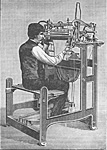
In the autumn of 1929, for the second year running, a shopping festival was held in the Town Hall. Local manufacturers exhibited a large number of their wares and Crowder Johnson took along an old hand-frame knitting machine, which was said to be 200 years old[14]. It is unclear when the Crowder Johnson family gave up their business as Thomas still advertised in Kelly's Directory published in 1932 and two years later he was still described as a hosiery manufacturer[15]. In 1932 Crowder Johnson made a life member of the Conservative Club, having completed 51 years of membership. This was to mark both the time he had been a member and "the enormous amount of time, money and work so ungrudgingly given to both the club and party". He was to recall that when the Club had moved to premises over Hartley's shop in Crown Square in 1882 he had carried their first billiards table up the stairs in sections[15]. One of his daughters was almost mistaken for Amy Johnson. When his younger daughter Nora, the wife of Basil O Jones, went to join her husband at Skopje in Yugoslavia in 1930 the aeroplane she was travelling on was mistaken for that of Amy Johnson, who was due to land there at a similar time. Mrs. Jones was said to have been astonished when people surrounded her plane. Amy Johnson arrived a little later and the two women even stayed at the same hotel[16].
|
||||||||||||
|
Both cards in the collection of and provided by and © Ken Smith. Small image of Mr. Skidmore and his machine in the collection of and provided by and © Glynn Waite. Images scanned for this website and information researched, written by and © Ann Andrews. Intended for personal use only. |
||||||||||||
|
[1] "Matlock Visiting List", 22 October 1902. [2] References for Tom Crowder Johnson include Kelly's Directory 1895 | Kelly's Directory 1899 | Kelly's Directory 1908 | Kelly's Directory 1912 | Kelly's Directory 1916 (gives national phone number) | Kelly's Directory,1925 | Kelly's Directory,1932. [3] Thomas was a teenager in the 1881 census. [4] William Crowder became a newsagent, having first been a framework knitter. See the 1861 census | the 1871 census | his advert in Croston's Guide | Kelly's 1891 Directory [5] "Derbyshire Times", 21 April 1894. Notice. William Crowder, hand-made hosiery manufacturer of Wellington House, Matlock Bank, thanked numerous friends for the kind support they have given him and announced his nephew would run the business from 1st May 1894 onwards. [6] "Derby and Chesterfield Reporter", 26 December 1902. Local Patent Applications. [7] He was still living with his uncle after he married - see the 1891 census. Ten years later, in the 1901 census, all his children had been born and Eliza Crowder was then living a couple of houses below the Johnson family. She died in 1917. [8] The 1911 census is available on Find My Past. [9] "Derby Daily Telegraph", 22 September 1925. [10] "Derbyshire Times and Chesterfield Herald", 17 January 1903. [11] Derbyshire Courier 19 October 1918. Death of William Wilson, aged 76. He had been employed at Smedley's at Lea before working for Crowder Johnson. [12] The 1921 census. William Crowder Johnson was still at his parental home and employed as a Frame Work Knitter Hosiery. [13] "Derbyshire Advertiser and Journal", 8 August, 1925. [14] "Derbyshire Times", 12 October, 1929. Matlock Trades Exhibition. [15] "Derbyshire Times and Chesterfield Herald", 10 December 1932. Letter written by the secretary, Mr. J. B. Richards, on behalf of the committee. [16] "Derbyshire Times and Chesterfield Herald", 10 December 1932. The newspaper reported that Mrs. Jones was joining her husband in Cairo, but that the event described had occurred "some time ago". It is most likely to have been in 1930 when the same paper reported that Nora Jones had flown to Skopje. [17] "Derby Daily Telegraph", Tuesday 5 July 1949. Obituary for Tom Crowder Johnson. [18] With grateful thanks to Peter Holden for an interesting and helpful
exchange of information. |

 Also see