|
Images Index> Matlock, 20th and 21stC Images> This page |


| Matlock: Riber Hall, 1926 - 1939 |
| Matlock, Twentieth Century Photographs, Postcards, Engravings & Etchings |
|
|||
"The ancient Manor of
Riber, or Riber Hall, was originally the property of this family [Wolley].
The pen and ink drawing above is from "The High Peak to Sherwood, The hills and dales of old Mercia", by Thomas Linthwaite Tudor (1926), published London by Robert Scott. With drawings by Fred Adcock and others. This drawing was done by Tudor. He only mentions the hall briefly, describing it as a "somewhat forlorn Elizabethan mansion, now made into two dwellings" and his drawing doesn't really show the hall itself. The gate piers are topped with ball-head finials, the front stone wall is finished off with balustrades along the top and the semi-circular steps leading up to the gate are distinctive. William Adam had commented in the 1857 edition of his book that "The balustrades are so unique and beautiful that we are induced to give a sketch or two" (the accompanying sketch is not included here)[2]. These features are Grade II listed today. Pevsner, in 1953, thought that "after the ostentatious picturesqueness of the Castle Riber Hall and Manor house are happy surprises, both of the genuine, unselfconscious picturesqueness of minor Elizabethan and early 17th century architecture in the county"[3]. Riber Hall and estate were for sale in 1914 - 16 fields of meadow, pasture and arable land, comprising 70 acres, 2 roods, 26 perches were on offer. The property was being sold by trustees of the late Thomas Sellors, and was acquired by Mrs Annie Outram of Riber for £17,000[4]. However, she died on 30 July 1922[5] and it was on the market once more[6]. At the same time Peter Gregory was offering 23 acres of mowing grass and Eating to Xmas at Riber, presumably referring to the grass as animal feed. The following year 27 acres of his land were for sale[7]. Mr. Gregory, who was a furniture broker with premises near the Boat House on Dale Road, had moved to Matlock from Tansley about 1893[8]. One of a number of advertisements in 1893 show him as a joiner and furniture broker of Firewood Works, Matlock Dale, with a side line as a buyer of all kinds of scrap metal[9]. 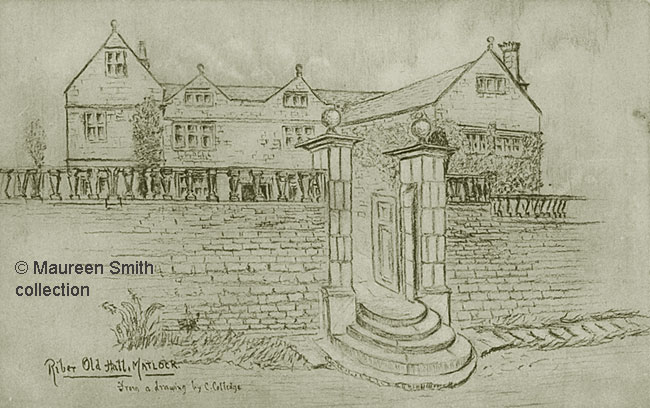 The second drawing is by the Matlock photographer Charles Colledge. On the back are the words: Peter Gregory's house. He bought, lived at and died there Dec 1929.
He died on 21 Dec 1929, aged 77; there was subsequently some controversy surrounding his internment as the then Rector of St. Giles', Rev. A. Urling Smith, wanted to charge his family a substantial burial fee as Riber was by this time outside the parish. This was despite Peter having lived in the parish for over 35 years. Unbeknown to the Rector, Sarah Gregory, Peter's wife, had already been laid to rest in the churchyard in 1917 but he sent the family's representatives away and, unsurprisingly, they did not return[11]. In 1930 visitors to Matlock were said to have been "privileged to view relics of national interest" at Riber Hall, by permission of the descendants of the late Mr. Peter Gregory, who was described as a well-known Derbyshire connoisseur. "This was the first time the public inspected the bedstead which Miss Florence Nightingale, who resided at Matlock, took all through the Crimean war. There was also the original spinning jenny invented by Sir Richard Arkwright, of Matlock, who became a millionaire cotton spinner after starting life as a halfpenny barber in Bolton, and the looms he used at his Matlock Mills at the end of the eighteenth century. A knife, said to have been the property of Mr. Coke, who was a well known highwayman in Nottinghamshire and Derbyshire, and an old man-trap were other exhibits"[12].This explains the comment on the back of another version of this postcard, posted on 31 Sep 1931, that stated that "we also discovered this Old Hall which is now a museum it was very nice"[13]. 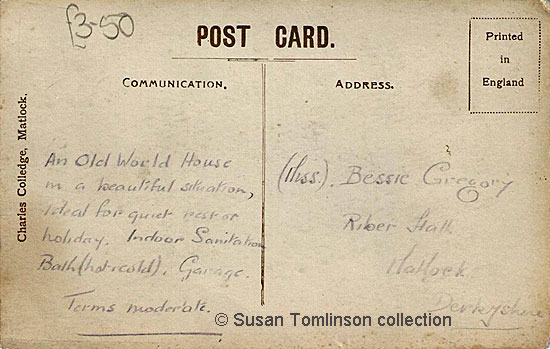 This is the back of a third postcard of the Riber Old Hall drawing. It was being used by Bessie Gregory, Peter's daughter, as a way of advertising the Hall as a holiday home. Charles Colledge, who was a friend of the family and an executor of Peter's Will, probably drew his sketch for either Peter or Bessie.
|
|||
|
1. Thomas Tudor drawing In the collection of, provided by and © a Private Contributor. 2. "Riber Old Hall, Matlock" from a drawing by C. Colledge. Published by Charles Colledge, Matlock. Printed in England. Unposted. © Maureen Smith collection. 3. "Riber Old Hall, Matlock" (back of) © Susan Tomlinson collection. Information researched, written by and © Ann Andrews. Intended for personal use only |
|||
|
[1] Footnote, "The Gem of the Peak" by W. Adam (1840) pub. London; Longman & Co., Paternoster Row. 2nd Edition - see transcript (scroll down to end of section). [2] "The Gem of the Peak" by W. Adam (1857, 6th edition). [3] Pevsner, Nikolaus (1953), "The Buildings of England, Derbyshire", Penguin Books. [4] "Derbyshire Advertiser and Journal", 19 June 1914. Riber Hall and Estate. [5] "ibid.", 05 August 1922. [6] "Ripley and Heanor News and Ilkeston Division Free Press", 9 March 1923. WEDNESDAY, MARCH 14th, at 12 o'clock sharp. - Riber Hall Farm, near Matlock. ... Instructions to sell contents and livestock by representatives of the late Mrs. A Outram. [8] Peter Gregory was a furniture broker on Dale Road, near the Boat House Hotel. [7] "Derbyshire Times", 16 February 1924. The 27 acres he was selling were adjoining the main Tansley and Riber Road. [9] "Derbyshire Advertiser and Journal", 21 April 1893. [10] "ibid.", 16 September 1927. [11] This unfortunate incident was reported in a number of newspapers. "Sheffield Daily Telegraph", 30 December 1929 (Rector's Explanation of Big Fee Request) and the "Derbyshire Times", 11 January 1930 (Matlock Burials. Statement Issued by the Rector). In various statements he gave Urling-Smith seemed astonished that they had not repeated their request! Also see Rectors of Matlock Parish Church. [12] "Sheffield Daily Telegraph", 23 April 1930. Interesting Relics at Matlock. [13] From one of two cards of Riber Old
Hall owned by Susan Tomlinson, with thanks. |


