The Grade II listed church is in the centre of the village, beside what used to be the turnpike road connecting Chesterfield
and Alfreton (now the A61). In his "History" of the village Gladwyn Turbutt writes that "The earliest
reference to a church at Shirland occurs in an interesting fine, dated 22 September 1226[1]" and
he goes on to comment that "a dispute of this nature could only have occurred a short while after a new church had
been built[1]". According to Nikolaus Pevsner it is "essentially a
fifteenth century church. The West tower has diagonal buttresses and eight pinnacles on the battlements[2]".
This was when the manor of Shirland was purchased by the Shrewsbury family during the reign of Edward IV (1461-1483). Reverend J. Charles Cox suggests the
family would have looked to re-build the church when coming into the estate[3].

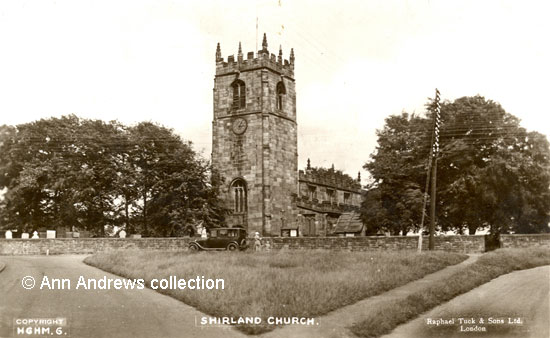
St. Leonard's Church, Shirland, the church tower and north side.
St. Leonard was a hermit - a Frankish nobleman - who settled near Limoges about the sixth century. Writing in 1875,
Cox observed that "the memory of this humble-minded hermit seems to have been formerly
regarded with much favour in England, for more than one hundred and forty churches still retain their dedications
to his name". ... "There are three other churches in Derbyshire dedicated to St. Leonard,
viz., Thorpe, Monyash and Scarcliffe[3]". The number has
increased and there are now around 180 churches dedicated to the saint.
The church and its congregation suffered from two absentee rectors. George Buckston was the first; having purchased the living in 1782,
he resided at Ashbourne[1] where he died in late 1826[4].
The second was Thomas Grinfield, who left the church in the hands of a number of officiating curates[5].
He had been appointed in 1827 and a replacement rector was not chosen until after his death in 1870[6]
when the curate-in-charge, Rev. Joseph Hall, was presented to the living. A Sunday evening service was introduced shortly afterwards.

St. Leonard's Church, Shirland, south side.
Many of the headstones shown in the two images below had disappeared.
Turbutt suggests that the roof of the nave was lowered to a less steep pitch in 1758; the churchwardens accounts for that year
show Thomas Siddall and others buying the wood and erecting a scaffold, as well as taking "the Lead of and Laying it
on"[1]. The cost of drinks for the workmen was also included.
St. Leonard's has undergone two major restorations, the first in 1848 and the second in 1929.
On 18th November 1847 a meeting of the parishes ratepayers was convened by the churchwardens. It was held at Hallfield-gate School
and was to seek a rate for re-pewing, re-roofing and other work to improve the parish church. Those attending were shown the architect's
estimate and both a plan and a rate for these repairs was agreed to without any opposition[7].
The architect was H. I. Stevens, Esq. In January 1848 a body called the Incorporated Society for promoting the Enlargement, Building and
Repairing of Churches and Chapels awarded a grant for the re-arranging of seats in the church[8].
The seating in the church wasn't the only problem as the roof was said to be very dilapidated by this time; the unsightly galleries inside
the church were also to be removed[9].
The church re-opened the following January. Part of it had been rebuilt and the whole of the interior had been restored "with
a due regard, not less to architectural effect that to the accommodation of the parishioners". Prayers were read by the curate,
Rev. Charles H. Ramsden, and the communion service by the Bishop, assisted by the Ven. the Archdeacon of Derby. Over
£40 was collected. There was no mention of the absent Rector taking any part in the proceedings[10].
The work had cost about £1,000. A new organ was installed in 1854, though it was replaced in 1885[11].
On Thursday, 2 September 1869 two services were held at St. Leonard's. The first was for the confirmation of candidates
from the parishes of Shirland and Morton, whilst the second was the consecration of an addition to the churchyard. The
extra land had been bought from Mr. John Clay for £111 14s 0d. An additional cost was the expense of building the
walls which completely closed in the churchyard, an "unsightly and irregular hedge on the south side having been swept away".
The churchyard fund had been raised by the almost night and day efforts of Messrs. John Baggaley, John Holmes, John
Tagg and Thomas Haslam[12]. Around a further acre of land had been acquired in 1894 and
tenders were being sought from stone wallers to build another wall[13].
The church bells were re-hung in 1875[14] and they were renovated and rehung on a
new frame in 1907[15]. They were cleaned again in 1933[16].
By 1890 the church clock needed replacing as it had not chimed for forty or fifty years. There had been a clock in the tower
for about 200 years but it had never told the correct time which must have made things rather difficult for clergy and parishioners
alike. It was mostly constructed of wood and was wound up with a rope! So at the time of Victoria's Jubilee the new vicar, Rev. R.
B. Stoney, obtained a replacement which can be seen on the tower in the top picture, below one of the louvered bell openings.
It was made by Messrs. G. and F. Cope of Nottingham and was fixed on iron brackets with wire ropes. The dial was six feet in diameter
and the pendulum weighed a hundredweight. It struck the quarters and chimed every hour and had cost over £100[17].
Further work to the fabric of the church was needed in 1929. At the annual parochial church meeting the chairman reported
on the "recent" restoration work which had seen the repair of the whole of the exterior. The pinnacles had been reset,
some of their stone bases had been replaced and two pinnacles had been renewed. The tower was repointed and the merlon stones
(the embattlements on the top) had been reset and refixed. Similar work was carried out elsewhere. The North aisle and north
wall of the nave were repointed. The ridge tiles on the chancel roof were also renewed and pointed[18].
A stone cross was erected over the porch in 1935[19] and more recently a
small statue of St. Leonard was placed in the niche above the door.
The Churchyard
In 1874 walks were laid out in the churchyard, shrubs and flowers planted and an excellent system of registering the graves
was introduced[14].
Although today the part of the churchyard surrounding the church has been largely cleared of its really old headstones,
some memorials are still to be found. These include what must have been a very costly large chest vault to the Bansall
family, which is of particular interest to me as Mary Bansall (1799-1844) had been a Clay before her marriage. Unfortunately,
these memorials here have not withstood the effects of circumstances, weathering and nature. Cox[3]
provides a photograph of the church (see below) and the Bansall memorial is on the left, close to the church porch; it surrounded
by iron railings that presumably disappeared (see below). When the web mistress last visited the church there was a
yew tree almost covering the tomb.

1870-75
This fourth picture, from Cox, is captioned Shirland
Church S.E. and was taken between 1870 and 1875, when the
volume covering the Hundred of Scarsdale of his history of
the churches was published[3].
It is a heliotype plate and is of such quality that the white
gravestone in the foreground is quite clear. The headstone
marks the grave of Ellen Bennett who lived in Higham; she was
buried on 2 May and was aged 65 when she died.
IN
AFFECTIONATE REMEMBRANCE OF
ELLEN
WIFE OF JAMES BENNETT
WHO DIED APRIL 28TH 1870
AGED 55 YEARS
HER END IS PEACE
A list of MIs for the church has been checked and Ellen's gravestone isn't listed[20].
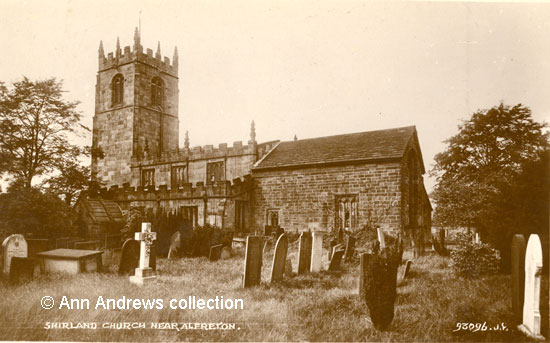
1926
There are also several readable, or partly readable, epitaphs
on the 1926 image of the church, above. The white marble headstone,
far left, commemorates Charlotte Hagger Siddall, who died in
1882; she was the daughter of William and Charlotte Page. Although
you can't see it here her mother, who passed away in 1897,
is also named on the stone[21].
Close by is a gritstone [chest]
tomb and, from its position, I believe it is dedicated
to Mary, the wife of George Bansall of Alfreton and daughter
of John Clay, who was buried at Shirland in 1849. Their chest
tomb has already been mentioned. Also commemorated on it are
some of the couple's children and two of their three grandsons.
The railings that surrounded it seem to have gone, although
there is a tomb next to the church porch that still retained
its railings in the inter war years.
The dedication on the white cross with the ornate carved motif
begins "In memory of George Beastall". The rest of
this dedication is hard to make out but George, who had moved
to Southport, passed away in 1899 at the age of 66 years.
On the opposite side of the old highway stands the old manor
house, now called Manor Farm, where several generations of
my Clay ancestors lived and farmed the land. The names of John
and Mary Clay, with the date 1746, are carved on the barn wall
of Manor Farm. The Clays in Shirland were part of the family
from The Hill, North Wingfield[22];
the branch of the family who lived in Shirland had come to
the village in 1695 and built Gables Farm in Higham (which
is in the parish of Shirland). The family finally left Shirland
in the 1870's, though younger sons had moved to Bonsall, Crich
(Dethick), Liverpool, Matlock and Nottingham before that date.
My Bryon ancestors farmed at Shirland Lodge.
Amongst the memorials inside the church is a marble tablet in memory of the web mistress's 3x great grandfather, John
Clay (1790 - 1865), and his two daughters, Sarah Lee and Mary Bray (see next page).
War Memorials in the Churchyard
Although there was a list of 24 names of the First World War casualties inside the church, Shirland
does not seem to have discussed erecting a war memorial in the aftermath of the First World War. Stonebroom's War Memorial was unveiled
in 1923; it was a clock on the church tower and the names of the war dead were on a plaque on below[23].
In 1928 a letter was published disassociating Stonebroom from Higham and Shirland as those two communities had "failed to do honour to
its brave fallen in the Great War". A scheme to build a war memorial in a side chapel in the south aisle was rejected at a parochial
meeting in 1933. It would have been made from some old oak from the rectory[25]. It is
not known why the parish took so long to discuss a memorial and why one was never erected.
However, a pair of wrought iron memorial gates with the names of the fallen from Shirland and Higham in both wars on two plaques
stand near the road at the north west end of the churchyard and have been used as a focus for Remembrance Day wreaths.
Shirland British Legion bought a Blue Cedar Tree in 1992 and dedicated it to those who had fallen in conflict. It was
planted on Remembrance Day 11 November 1992 and a commemorative plaque was placed in the church porch.

War Memorial Shelter, Shirland Churchyard
This is next to the gateway between the old churchyard and the churchyard extension. There is a Latin Cross on the outer wall and on the end
wall is a grey slate tablet with white letters, bearing the names of 74 people who were casualties in both the first and second world wars.
The list includes casualties from Shirland, Higham and Stonebroom and combines the lists of casualties from both churches.
Shirland Parish Council have discussed erecting another memorial on the green.
Other Derbyshire churches where the Clay family worshipped, were christened, married, buried or otherwise associated with,
can be seen by clicking on the images below:
|




 The Gentleman's Magazine Library - Derbyshire to Dorset