|
Images Index> Images of People> This page |


| Canon Kewley & His Sisters |
| People who lived in the Matlocks : Photographs, Photographs, Postcards, Engravings & Etchings |
The album now belongs to the Ash family and was in the possession of Ray Ash's step-grandmother Ash (Dora May Wheeldon before her marriage), who was for many years companion and housekeeper to Mrs. Wildgoose at Stoneycroft. Unfortunately Mrs. Wildgoose was not very good at putting dates in her album, so some of the dates are only approximations. The five photographs from the album are published here with kind permission of Ray Ash.
|
|||||||||||||||||||||||||||||
Canon James William Kewley
Photographed in the grounds of The Gables, which later became part of Lilybank Hydro, probably between 1900 and 1905. |
|||||||||||||||||||||||||||||
Canon Kewley was one of twelve children born to James and Eleanor Kewley at Castletown, on the Isle of Man. His father worked in the Rolls Office there and the family lived in a house within the castle walls that was originally built for Lord Derby. James William was their second son; he was born on 2 February 1846[1] and baptised 13 days later. He was the elder of two sons who survived their childhood and had five older sisters, several of whom lived with James in Matlock at various times[2], as well as some younger siblings. James had been a pupil at King William's College on the Isle of Man[3] and became an assistant master at Rev. Spyer's boy's boarding school on Princes Walk, Weybridge, Surrey for a time[4]. He was granted a license to a curacy at St. Werburgh's, Derby in 1874[5]. He then studied at Lichfield Theological College, which was on the south side of Cathedral Close, and was ordained as a priest by the Bishop of Lichfield on Trinity Sunday, 1875. In 1881 he was still Curate of St Werburgh's Church, Derby and was living in Friar Gate[7]. Later that year began to work with his sister Margaret at Derby Diocesan Training College for Schoolmistresses; this was callled Lichfield Diocesan Training College until at least 1887.
The Vicar of Eadon, Southwell, had twice refused the rectorship at Matlock before it was offered to J. W. Kewley, who accepted the post with the proviso that the cost of "repairing the dilapidated condition of the rectory buildings did not fall on the incoming rector". A compromise was reached and he proved to be a very good choice[11]. In 1915 he was appointed an honorary Canon of Southwell Cathedral, in succession the late Canon Atkinson[12]. During his time as Rector James Kewley was involved in a number of Church restoration projects (see links to more info lower down the page). For example Benjamin Bryan, writing in 1903, said that "the present rector having provided the means, the basement of the [church] tower has been opened into the nave by the erection of a four-centre arch of old oak under the front edge of the ringing chamber floor"'[13]. He was very supportive of the soldiers who volunteered, and of their families when they were killed, in the First World War. At a Memorial service to commemorate the life of Samuel Henstock in 1915, Rev. Kewley stated that "Matlock is forming its list of young Christian heroes, its highest roll of honour. The names of Guy Bonham Carter, Walter Bagshaw, George Thompson, Sidney Smith and others are there already"[14]. He was to record a Roll of Honour for Matlock during the First World War. He also listed the names of 810 Matlock men who were in uniform in late 1917 and prepared a souvenir for the relatives of both those who were serving and those who had died in the conflict up to that point. It was given to people who attended a Memorial Service in the Church on 18th Nov 1917[15]. In 1920 it was reported that "Canon Kewley, rector of Matlock, is unable to retire because he cannot get a house to live in"[9]. When he finally retired on 21st December 1922[9] James Kewley did not leave Matlock; he and his surviving sister, Harriet Elizabeth, moved to "Cronk Beg" on Church Street, not far from the Rectory. James and Harriett Kewley drew up their wills in 1930; they were almost, but not quite, mirror wills. After he resigned William Nathan Statham wrote a fitting tribute, believing that Canon Kewley's departure would be regretted by "the whole of the inhabitants of the parish, of whatever creed or denomination"[16].
When he celebrated his 86th birthday in 1932 it was said that he then still has excellent health. According the newspaper report the name of the home he shared with his surviving sister Harriett was named "Cronk-e-Creagh" meaning "Hill of the Heart" in Manx[17]. However, when he died almost three years later it was revealed that had been in failing health for some time, and had been very seriously ill recently. "His notable and arresting figure has been seen about town rarely of late" and his presence was clearly missed[18]. He died, aged 88, on 25 January 1935[19] and was buried in St. Giles' churchyard alongside three of his sisters[20]. Dr. Pearce, Bishop of Derby, and Matlock's then Rector the Rev. Urling-Smith conducted the service. He was interred in the family vault, wearing his priest's cassock, surplice, slippers and stole. Amongst those present were W. N Statham who had been churchwarden for much of Kewley's incumbency, the Council Chairman Lubin G Wildgoose, Rev. Chippett of Riber School and W. H. Nixon of All Saints' Church as well as other local clergymen[20]. Another sister, Fanny Dodd, who died in Oxfordshire is also buried in the churchyard and his brother in law Thomas is mentioned on her headstone[21]. Amongst the bequests in James Kewley's Will was a gift of £800 to King William's College, IOM, to found an exhibition to Oxford
or Cambridge and a £150 science prize from the income. Other gifts included £100 each to St. Giles' Church, St. Andrew's
Home - for giving any boys a start in life (something he took a keen interest in), the Derby Diocesan College for Training Schoolmistresses
and Ernest Bailey's Secondary School for the income for prizes for religious knowledge[9].
Canon Kewley was still president of St. Andrew's Home when he died[21]. 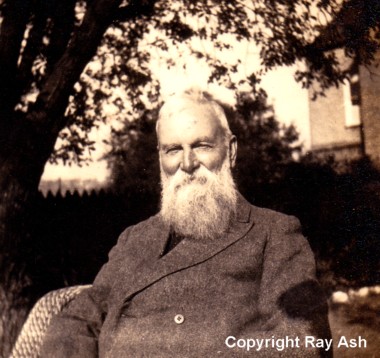 Canon Kewley photographed a few years later. Eleanor Christian Kewley (16 Feb 1837 - 6 Sep 1916) 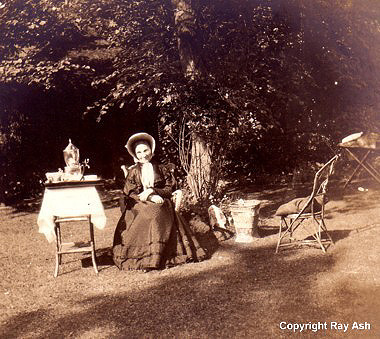
Eleanor was a Certificated Teacher at Four Roads, Rushen on the Isle of Man in 1871. In 1875, when Jane Cannell of the Isle of Man attended Warrington Training (Mistresses) College, it emerged that she had been a pupil teacher at Rushen under Miss Kewley, who has proved herself one of the most painstaking and successful teachers in the Island[23]. By 1881 Eleanor was the School Mistress of East Street (or East Road) Girls School in Rushen (the same school). She retired at the end of 1890 after more than 27 years as headmistress of Rushen Girl's School, and on the 9th January 1891 a presentation was made to her by the vicar, Rev. Blundell Browne. He said "we hope you will look on these tokens of regard ...as expressions ... of our true appreciation of your long years of devoted and loving work on behalf of the girls of this parish" adding that "for years to come this parish will feel the unremitting attention you have bestowed on the mental and moral well-being of the large numbers of children who have been under your wise and gentle charge[24]". In the 1891 census a few months afterwards Eleanor was living with both her widowed mother and younger sister Harriet in Malew, Castletown[25]. Some time after their mother died in 1893 the two sisters moved to Matlock. She was one of a number former school teachers on the island who received a pension in 1898[26]. Eleanor was with their brother at the Rectory by the time of the 1901 census[2]. She contributed to parish life in her new home through her work with children and was the superintendent of St. Giles' Sunday School. She was also described as an indefatigable church worker. In one brief report of her death it was said that she had been ailing for some time, but her death would be a great blow to the parish church[27].
Margaret Jane Kewley (11 Mar 1840 - 30 Jan 1922)
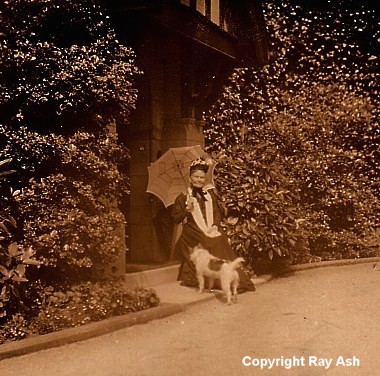
However, she had been at her brother's home in 1891; it is assumed she was visiting him then, although the census does not say so[2]. There was a strong resemblance to her brother. After James left the Derby College Margaret worked with three more principals, "her energy never slackening and her work maintaining its high standard"[30]. At the annual prize giving in 1894 The Bishop of Southwell spoke of the regard all must have felt for the valuable work of the principal and the management of the school by Miss Kewley, the lady superintendent[31]. By 1898 the college had over 80 students and over the previous 17 years there had been just three patients who had became ill and needed to be nursed in the sick room[32]. In the summer of 1903 her imminent retirement was announced. According to the press, she "not merely performed her duties in
a merely perfunctory way, but has actively and devotedly associated herself with the work, and taken the deepest personal interest in
the welfare of the students. She has now determined to seek a well-earned retirement. ... At its annual meeting in 1912, which Margaret Kewley attended, the college launched another appeal - this time for a new art room. It was announced that "since the opening of the college about 1,800 schoolmistresses had been trained and they had found work in both Church and Council schools[34]. Her final home was in Matlock, living at the Rectory with James, Eleanor and Harriet. After her retirement she acted as honorary secretary for the college in the Bakewell Deanery[35]. Following Eleanor's death she was referred to as "Miss" Kewley. Margaret was buried in St. Giles' churchyard on Thursday, 2nd February 1922 in the same family grave as her sister Eleanor and later her brother and their youngest sister Harriet Elizabeth. Rev. J. W. Chippett of Riber School conducted the service for Magaret; he was assisted by Rev. Canon Bater, Principal of the Training College at Derby where she had worked, and Rev. H. Pattinson. Amongst the floral tributes was one "From the Committee, Staff, and Ex-Students of the Training College, Derby, in remembrance of many years of devoted service and Faithful friendship. R.I.P."[36] One of the obituaries published shortly afterwards summarised all she had stood for in her career :
Harriet Elizabeth Kewley (3 Dec 1851 - 15 Apr 1934) Harriet Elizabeth[38] also did not marry; she and Fanny (b. 1856) were still with their parents at Castle House in 1881 but after her mother's death moved to Matlock to live with her brother and two of her sisters[2]. In 1901 she was back on the Isle of Man, visiting their married sister Fanny and her husband at their home "Cronky Chree". Katherine H. (Kate) Bailey, Ernest Bailey's sister, was accompanying her[29]. She and Margaret attended the big society wedding of Miss Olive Marsden-Smedley in 1919 and her attire was mentioned. It "was of black satin worn with a brown hat trimmed with ostrich feathers"[39]. Following her death it was said that Harriett had kept house for her brother James for the greater part of half a century and had been an ardent worker for the Parish Church[40]. She was 82 years old when she died. Whilst her brother was not well enough to attend, he did send flowers. Mrs. Robert Wildgoose, was amongst the numerous friends who were present her funeral on 18 April[41]. Although Kate Bailey had died in 1928, her brother was at the graveside to pay his respects as were the two children of her sister Fanny. As Pamela Ward has more recently observed, James outlived them all. The following year the final home she and James had shared in Starkholmes, and which she owned, was auctioned
at the Horse Shoes Hotel on Matlock Green by W. H. Marriott[42]. 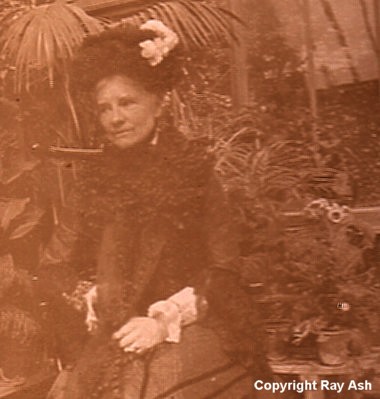 Photographed in the Conservatory at The Gables. Initially thought to be Margaret Kewley, the photo may have been of Harriet.
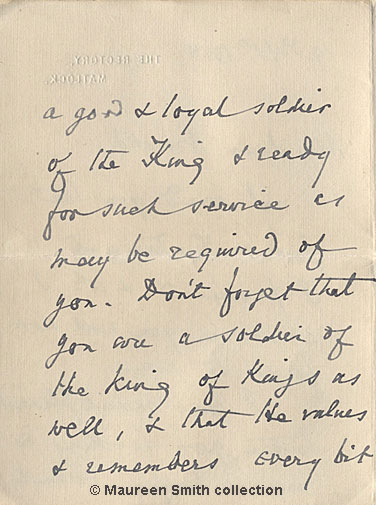
Bible dedication and accompanying letter sent to a WW1 soldier
View even more about the church by clicking on the images below:
|
|||||||||||||||||||||||||||||
|
Photograph scans © Ray Ash. Letter and Hursthouse information © Maureen Smith collection Research provided by and © Ann Andrews.. Pamela Ward, a descendant of one of the Canon's sisters, has also provided some information. Intended for personal use only. If you have any further information about the identity of anyone in the photographs we would like to know. Please contact the web mistress who will pass it on to Ray Ash. |
|||||||||||||||||||||||||||||
|
[1] From obituaries in the Matlock Visitor and the Derbyshire Times, with thanks to Pamela Ward. His christening took place at Castletown St Mary on 15 Feb 1846. [2] Canon Kewley was living in Matlock with one or more of his sisters in both the 1891 Census and the 1901 Census. By 1911 three sisters - Eleanor Christian, Margaret Jane and Harriet Elizabeth - were living with their brother at The Rectory. He is also listed in the following on site trade directory transcripts: Bulmer's Directory 1895 | Kelly's Directory, 1908 (officials) | Kelly's Directory 1912 (Private Residents) | Kelly's Directory, 1916 | Kelly's Directory, 1916 (officials). [3] King William's College register of former pupils, with thanks to Pamela Ward. [4] He was living at the school in Weybridge, which was somewhere near the station, in the 1871 census. [5] From "Staffordshire Sentinel", 3 June 1874 and "Hampshire Advertiser", 27 June 1874, Licenses to Curacies. [6] Information from "Derby Mercury", 2 June 1875, the "Shrewsbury Chronicle", 28 May 1875 and the "Clergy List", 1896. [7] 1881 census, Derby, RG11/3399 f32 p15 s74. [8] "Kelly's Directory of Derbyshire", 1887. [9] "The Times", 25 July, 1935. Notices of Wills and Bequests. [10] "Derby Mercury", 22 Feb 1888. Derby Training College. [11] "Derbyshire Courier", 21 May (Vacant Rectorship) and 4 June 1887. [12] "ibid.," 27 March 1915. Announcement of appointment. He continued in this position until 1925. [13] Bryan, Benjamin (1903) "History of Matlock - Matlock, Manor and Parish" London by Bemrose & Sons, Limited. [14] "Belper News", 25 June 1915. [15] Beresford, Charles (2007) "The Bath at War, A Derbyshire Community and the Great War", Country Books/Ashridge Press. ISBN 978 1 901214 91 8. Also see Matlock & Matlock Bath War Memorials [16] "History of Matlock Parish Church ", W. N. Statham, (1925) Printed by Geo. Hodgkinson. Mr. Statham had acted as one of his churchwardens for many years. [17] "Derbyshire Times", 30 January 1932. [18] "Derbyshire Courier", 1 February 1935. Death of Former Matlock Rector. James Kewley was almost 89 years old. [19] "The Times", 29 Jan 1935. Death announcement, stating that he was Rector at Matlock 1887 - 1922. He had died at Matlock on 25 Jan, aged 88, and his funeral was the 29th. More than one obituary ("Sheffield Independent", 26 January 1935) stated that he was an authority on the Max language. [20] "Derby Daily Telegraph", 26 Jan 1935 and "Nottingham Journal", 30 Jan 1935. [21] Memorial Inscriptions, a Surnames Index. Also see: Matlock St Giles, MIs in the Church. [22] Miss Kewley was christened at Castletown St Mary on 26 Feb 1837. [23] "Isle of Man Times", 10 April 1875. [24] "ibid.", 17 January 1891. Rushen. [25] The 1891 census, held on 5 April 1891. [26] "Isle of Man Times", 31 December 1898. Amongst a list of "school teachers on pension in the island" was Mrs. [sic] Eleanor C. Kewley. It is not clear whether Eleanor was still living on the Isle of Man at the time, although it is probable that she had not yet moved to Matlock Rectory. [27] "Sheffield Independent" and the "Sheffield Daily Telegraph", 8 Sept 1916. [28] "Kelly's Directory of Derbyshire", 1895. Kelly's 1891 Directory also records her on Uttoxeter Road, but does not provide a number. [29] 1901 census, taken on 31 March 1901. [30] "Derbyshire Advertiser and Journal", 16 Jul 1898. [31] "ibid.", 23 November 1894. [32] "ibid.", 16 Jul 1898. [33] "ibid.", 3 July 1903. [34] "Derby Daily Telegraph", 23 November 1912. [35] "Derby and Chesterfield Reporter", 3 March 1922. [36] "Derbyshire Advertiser and Journal", 10 February 1922. Obituary for Margaret Kewley. The following year, in the same paper, on 30 June 1923 - "Twenty years ago" - also mentioned her and her retirement from the Derby college. [37] "ibid.", 10 and 11 February 1922. Death of Miss Margaret Kewley. [38] Harriett Elizabeth was baptised at Castletown St Mary on 3 Dec 1851. [39] "Derbyshire Advertiser and Journal", 28 March 1919. Marriage at Christ Church Holloway. Miss Marsden-Smedley married Lieut.-Col. John Henry Foster. Whilst the Bishop of Derby performed the service, Canon Kewley was one of three local priest assisting. He had given the couple an antique Chippendale chair, formerly owned by John Smedley. His sister Harriet's dress was one of a number described. [40] "Derby Daily Telegraph", 17 April 1934 and "Derbyshire Times", 21 April 1934. [41] "ibid.", 19 April 1934. Matlock Funeral. Tributes to Sister of Former Rector. [42] "Derbyshire Times", 22 February 1935. Sale notice. The Exors. of Miss H. E. Kewley, Deceased, were to sell the semi-detached residence "Cronk Beg" with Vacant Possession on completion. [43] Arnold Walter Hursthouse can be found with his parents in the 1901
census. His RAF service number was 100806. He lived with his parents at 2 Dean Hill Villas and his father was already serving
in the Royal Engineers. |


 Eleanor Kewley's Memorial in St. Giles' Church