|
Images Index> Matlock, 20th and 21stC Images> This page |


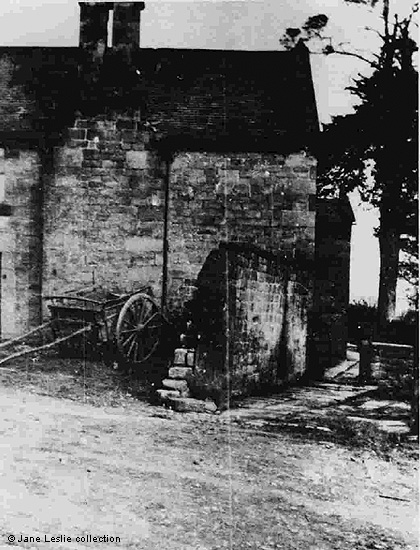
| Matlock: Allen Hill Farm |
| Matlock : Twentieth Century Photographs, Postcards, Engravings & Etchings |
|
|
||||||||||||
Perhaps the most interesting story about the Wolleys of Allen Hill is the Memorial Inscription in St. Giles' church for an earlier Adam Wolley and his wife Grace. The couple were married for 76 years and survived the English Civil War. Adam was born about the time Queen Elizabeth I ascended the throne and died, aged 99, when Oliver Cromwell was the Protector of the Realm. His wife Grace was born during the reign of Elizabeth and died after Charles II had returned from exile; she was 110 years of age[5]. 
During the nineteenth century the names associated with the farm were those of Sybray, Stevens, Slack and Taylor[9]. The parish registers also record burials for Scorers and Knowles in the period 1820 - 1834. Frederick Taylor seems to have been the last of the farmers at the property, which had ten rooms[10]. In 1921 he was living with his mother Sarah Ellen, then 81 years old. Other members of the household included his 3 year old son John Frederick and his 28 year old nephew John Frederick, who was assisting his uncle. Frederick Taylor of Allen Hill died on 31 August, 1926 and his mother, who survived her son, advertised the household furniture and effects for sale later that year. Sarah Ellen died in February 1927, aged 87. 
 Allen Hill Farm from Masson, 1890s |
|||||||||||||
|
Photographs scanned by and © Jane Leslie from her personal collection especially for this web site. Additional photo from Gilly Sanders' collection. Information researched, written by and © Ann Andrews. Intended for personal use only. |
|||||||||||||
References: [2] Footnote to p.30 in William Adam's "Gem of the Peak" (1840). [3] Adam Wolley was baptised in 1758 and buried in 1827 at Matlock. View his baptismal record | burial record | MI in the church | Reference to his Will - see Pre 1858 Wills. Date of death published in both the "The Standard", July 25, 1827 and "The Morning Chronicle", Thursday, July 26, 1827. [4] See the Wolley Manuscripts, Matlock | Documents relating to the WOLLEY family in the Wolley Manuscripts. The Documents held at the British Museum are also referred to as the Wolley Charters, but the Charters are only part of Adam Wolley's collection. [5] Read the MI for Adam and Grace Wolley at St. Giles' [6] Cameron, Kenneth (1959) "The Place Names of Derbyshire", Part II - English Place-Name Society Volume XXVIII Cambridge University Press [7] George Wolley was buried at St. Giles', Matlock. He wrote a Will - see Pre 1858 Wills. [8] "The Derby Mercury", Thursday, January 14, 1808. [9] Nineteenth century occupants of Allen Hill Farm included: [10] The building was described as having 10 rooms in the 1911 census - see FindMyPast although in 1921 it was recorded as having 9 rooms [11] From a Scrap Book by Basil Sowter (Allen Hill, D2386Z, County Record Office), about 1920/1. John Simpson had written to Basil Sowter on 30 Aug 1921. [12] Dates provided with these photographs.
|