|
>This page |


| Stone Quarrying in the Matlocks |
| Quarrying for both limestone and gritstone has been a major industry in Matlock and Matlock Bath |
       |
|||||||||||||||||||||||||
| Matlock & Matlock Bath Index About Matlock | About Matlock Bath | Images | Find a Name Historical Records | The Wolley Manuscripts |
|||||||||||||||||||||||||
Late nineteenth century advertisement, from Kelly's Directory[1891]
Before the development of the Britain's canal system and the railway network farmers would have their own quarries. Production was small in scale and where the underlying, or outcrop of, rock was limestone local farmers would also have had their own lime kiln[2]. So when John Smedley was building Riber Castle, for example, he used stone from a quarry on Riber Hill just a short distance to the north east of his castle[3]. The large blocks he needed did not have to travel far. Demand for local stone increased when it became easier to transport the raw materials further afield. George Stendall Drabble's advertisement, above, is an excellent example of the many uses for Matlock and District's stone, which was used in country wide building projects[1891]. His brother, Mr. Thomas Cooper Drabble (1844-1900), owned quarries at Bentley Brook, Farley, Cromford and Matlock Moor though his business amalgamated with the former Darley Dale stone quarry (the Darley Dale Stone Company) in 1897. They became the Stancliffe Estates Company Limited, chaired by F. C. Arkwright of Willersley, with Mr. Drabble and Mr. J. H. Dawson as managing directors[4]. Stone from Bentley Brook Quarries was used to build the depot for Matlock's Cable Tramway on the corner of Rutland Street and Wellington Street the following year[5]. The main gritstone quarries in 1903, when Benjamin Bryan was writing his "History"[3], were at Cuckoostone, on Matlock Moor, and in Lumsdale. The stone from these quarries was used for making millstones and grindstones and for local buildings.  Gritstone outcrop, Jackson Tor, Matlock Bank. Jackson Tor was a former quarry and the exposed stone in the photograph has clearly been cut at some stage. There are other disused quarry sites close by, including Bank Quarry to the west (hence the road called Quarry Bank off Smedley Street West).
For many years the stone would have been taken to the station on a drug, a low horse-drawn cart without sides. Stone drugs were in use for a long time. The first reference for one found to date was in 1824 when a Sheffield man was fined 10s. for "riding on a stone drug and not having proper care of his team"[8]. Unfortunately, they could also cause damage. For example, Thomas Beck was told off by Matlock Local Board when a tail pole on his drug damaged the road (see Matlock Station Stone Yard: Messrs. Beck, Boden & Drabble). When a large lamp pillar was knocked down in the Dimple in 1897, a stone drug slipping on a greasy road was the culprit; a carter employed by T. Cooper Drabble was found to have been responsible on this occasion[9].
Limestone was used also as a flux in blast furnaces when smelting iron; lime-burning also took place in the district. The stone was also used as railway ballast, for making building mortar, cement and ground for agricultural use. "Parish" or the town quarry was on Dale Road opposite the footbridge across the river at
the beginning of the twentieth century[3] and limestone was
quarried here. This quarry became known as the Harvey Dale quarry. Next door to it, behind the Boat
House Hotel, was Holt Quarry[11]. In 1930 Messrs. J. Greatorex
and sons, the limestone quarry owners and tarmacadam manufacturers of Harvey Dale Quarries, bought the Dale
Road quarries, having already purchased Holt Quarry from Thomas Shaw. This gave them a monopoly, with sole quarrying rights from the Dale to Holt Lane[12]. In late 1935 the Harvey Dale Quarries were under the ownership of the newly formed Derbyshire Stone Ltd.[13] who became big employers in the district[1941]. At different times over the years there must have been other Parish Quarries. In 1848 there were five; Lumshill, the Wishing stone area, Jackson Tor, Harvey Dale and a piece above Starkholmes. At the time, Holt, accessed via the lane by the Rock Inn, was owned by Wm Smith & Brother and occupied by Wm Webster[11].
The Matlock Bridge Limestone Company at Cawdor had been taken over by 1886 and in 1891 William Edward Constable & Co were listed as tar paving contractors there; their stone was used in asphalt macadam.[1891] Constable became Constable, Hart & Co. and their quarrying activities at Cawdor eventually became part of Derbyshire Stone. At the beginning of the twentieth century Josiah Smart took "the field between the station and the Snitterton road, which overlies the limestone rock"[3] and successfully applied for a licence to store explosives there in 1902[17]. Smart advertised as a tar paving contractor at Matlock; he also owned Station Quarry, close to the railway tunnel entrance at Matlock Bath, which he purchased in 1915[18]. By 1922 the Station Quarry in Matlock had expanded considerably and by the maps of 1967 Cawdor and Station quarry were almost joined, extending almost to the edge of Snitterton Road. The two quarries were operating as one concern by 1931[19]. By the 1970s the Hall Dale quarry, slightly higher up on the Masson hillside between Snitterton Road and Salter Lane, had also become large. It had been opened by Derbyshire Stone in the 1950s but is no longer quarried.  The former Hall Dale Quarry, about 2008. It was not opened by Derbyshire Stone until 1950 and was abandoned by Tarmac in the 1980s[20]. The 1965 (K2860-SK2960 - AA) and 1971 O.S. maps (SK26SE) show a very large are of land was being quarried. Nevertheless, the surrounding scenery was always beautiful, whatever one thinks of such a large quarry in its midst.
Derbyshire Fluor Spar Co. Ltd. were mineral merchants at High Tor works in Matlock Dale 1932[1932]. Quarrying for fluor spar also took place in the Upperwood area of Matlock Bath and in what had been the grounds of the original Matlock Bath Pavilion[22]. However, fluor spar was mainly mined and lead was found amongst the fluor spar rock. Whilst providing both employment and building materials for local people, it was the existence of the large quarries that prevented Matlock from being included in the Peak District National Park. Many will recall the warning whistle followed by the thump of the blast, the dust that seemed to cover everywhere and the large lorries with their massive tyres thundering along the narrow local roads.
The conflict between need and nature is highlighted in the poem by the English poet John Betjeman, a visitor to nearby Chatsworth and a friend of the Duke's family, in his poem entitled 'Matlock Bath'[23] . On 31 March, 1999 a newspaper article by Linus Gregoriadis was published in The Independent which also drew attention to conservation matters and used the extract below from Betjeman's poem[24]. From "Matlock Bath"
In addition to the one at the station, Matlock Bath's quarries also included the former Long Tor Quarry on Dale Road (see link below). One of Matlock's longest living residents, Thomas Green of the Rock Inn, had worked as the Manager at Long Tor for Mr. S J Claye of Long Eaton Ironworks. In 1909, aged 97, he said spoke of the blasting ruining the beauty of the rock, although the quarrying provided employment[25]. Two quarries were started in Matlock Bath in the 1850s, both owned by a London solicitor. Francis Blake had inherited a considerable amount of land on the hillside that also bordered the Derwent (roughly part of North Parade, Holme Road, Brunswood Road and Long Tor area today[26]). He opened two limestone quarries on the opposite side of the road from the river just before May 1855[27]. One was centred on the site of the former Methodist church on North Parade - the quarry face is especially obvious behind the building - and the second was Long Tor. Blake was "engaged in getting Limestone out of my estate in Derbyshire, and selling the same in Staffordshire"[28]. In the October one of his working horses was waiting on the turnpike road when a heavy fragment of stone flew over a building following a blast and caused its death[29]. The following year Peter Arkwright took him to court for dumping waste from the quarries into the Derwent, resulting in insufficient quantities of water being stored in the river for Masson Mill's use (see River Derwent, Masson Weir). Thomas Wakley was involved in the purchase of Francis Blake's Matlock Bath estate[30]. By 1857 Wakley, in partnership with John Weston and described as both of Matlock Bath, were placing notices in Birmingham and Staffordshire newspapers advertising to Ironmasters there: "Derbyshire Limestone from Matlock Bath Quarries lately worked by Mr. Blake". This stone was claimed to be "superior to any in Derbyshire, being the purest carbonate of lime, free from sulphur". A sample could be examined at the Great Bridge Railway Station (Tipton)[31]. Unfortunately, in January 1859 a nine year old boy, Anthony Brookes, was killed whilst was helping drill a hole in the bottom of one of their quarries, probably Long Tor. Following a normal warning, he slipped and fell whilst getting out of the way of a heavy stone being rolled down the hillside[32a]. At the end of that year Thomas Wakley and John Weston, as Stone Quarry Proprietors, dissolved their partnership in Matlock Bath[33]. The quarry in Matlock[7], owned Long Tor quarry at the beginning of the twentieth century but could not make it a going concern[11] [34]. It was later run by first George Crowther and then by Job Greatorex[34]. There were two basalt quarries in the Dale opposite High Tor, between the High Tor Guest House and the houses surrounding Riversdale. A quarry on Temple Road, shown as no longer in use on very early OS maps, also existed at some stage.
Joseph Statham of Riber, who was 50, was working at the stone-crushing plant at Cawdor in 1915 when he became entangled in the machinery, which threw him into the running shaft and on to the roof. He was killed instantly[41]. In 1922 William Frost, who worked for Smarts as a foreman blaster, was badly injured when a stone knocked his feet from underneath him as he was standing on a 40 foot high ledge. He fell to the base of the quarry and died two days later at Whitworth Hospital[42]. Ernest Carline (46), of Scarthin, was struck on the head by a piece of falling stone at a quarry in Matlock Dale in 1926. He also died at Whitworth, leaving a widow and a large family[43]. Fred Flint, a single young man, of Cross Green, Darley Dale was working on the rock face in 1928 when he lost his footing and fell 16 feet into the bottom of the quarry. The men would not wear the harnesses at that time as they got in the way[44]. However, possibly the worst accident was in 1929 when Joseph Taylor (53) of Wensley and Herbert Holmes (28) were killed within twelve hours of each other. Joseph Taylor was killed when 20,000 gallons of tar exploded and he was caught in the flames. Herbert Holmes fell into a crusher, having been hit by a 15 cwt. [hundredweight] piece of stone that became dislodged[45].
Derbyshire Stone's quarries did eventually address the limestone dust issue, which was said to be particularly bad in dry summers. Harvey Dale Quarry was operating as a "wet mix" plant by 1958 in an effort to reduce the dust. Much was said to be being done at Cawdor - the worst offender at one time - as well; a dust collecting plant was to be completed by the end of March the following year[47]. Trees were also planted at Harvey Dale to screen the quarry faces.
 Post WW2 Advertisement to encourage people to join Derbyshire Stone's staff.
A company statement was issued in August 1967 announcing that "a substantial part of their Cawdor Works will shut down at the close of business on Friday 27 October 1967". Much of the plant was uneconomic as it had been installed over forty years before. Hall Dale was to continue as well as some ancillary works and the Engineering and Transport Departments were unaffected[50]. Lack of orders for its products were given as the reason for further redundancies and closure in 1986[51]. Derbyshire Stone moved into a purpose built office block, John Hadfield House, which was opened on 23 August 1968[52]. The company was taken over by Tarmac Ltd. the same year. In 1990 they were planning to sell two mines, which would have reduced some of the numbers of those employed at their Matlock headquarters. Tarmac left the building in 1997; it was afterwards used by the County Council and was later demolished.  This panoramic view of Masson provides a sense scale and shows just how extensive the quarries were. The photograph was taken from Farley Hillside on a misty June morning on 23 June 2001. Hall Dale quarry is just below the skyline. Cawdor Quarry is about a third of the way up, on the right, though is not easy to see. 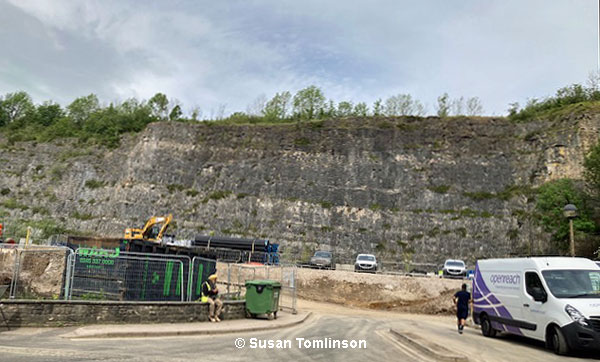 Summer 2026. John Hadfield House, behind the former Boat House Inn (now a vets) on Dale Road, had been demolished and the former quarry site is being prepared for a new supermarket. The photo of the quarry face shows us just how much stone was removed from the hillside over many years of quarrying here. Elsewhere on the website:
Also see: The Peak District Historical Mines Society has the following available: To view the PDF file, you may need to download the free Adobe
Acrobat Reader. |
|||||||||||||||||||||||||
|
Images of Cawdor and Hall Dale Quarries supplied by and Copyright © Paul Kettle. Derbyshire Stone advertisement part of Jane Leslie's personal collection and photographed especially for this web site by Andy Andrews. Daale Road former quarry photograph supplied by and Copyright © Susan Tomlinson. Other Images Copyright © Ann Andrews. Information written and researched by and © Ann Andrews. Intended for personal use only. |
|||||||||||||||||||||||||
|
[1] "The Victoria History of the English Counties. A History of Derbyshire Vol. I.",
Constable & Co., Pall Mall, London (1907) : (Ed. 1970) University of London. ISBN 0 7129 0447 6, p. 365. [2] Willis, Lynn and Parker, Harry (1999) "Images Of England: Peak District Mining and Quarrying", pub. Tempus Publishing Limited, Gloucester ISBN 0-7524-1710-X. [3] Bryan, Benjamin (1903) "History of Matlock - Matlock, Manor and Parish" London by Bemrose & Sons, Limited. [4] "Derbyshire Times", 2 October 1897. [5] "ibid", 22 October 1898. See: Bank Road & the Steep-Gradient Tramway. [6] See Matlock & Matlock
Bath's MIs, Monumental Masons - St. Giles' Church, compiled
by Derbyshire Ancestral Research Group (there are also Contact
details for the group). [8] "Sheffield Independent", 31 January 1824. [9] "Derbyshire Times" 10 April 1897 and and 3 May 1897. [10] "The Derby Mercury", 14 January, 1885. [11] Colin Goodwyn has most kindly checked
the Annual Returns of Quarries under the --- Act for 1925 and 1931. [12] "Derby Daily Telegraph", 3 November 1930. Matlock quarry merger. Greatorex's had already bought Holt quarry from Mr. W. B. Shaw when they merged with the Dale quarries of Mr. Alfred Shaw. Messsrs. Greatorex also purchased the quarrying rights of Platt's estate, giving them a further 18.5 acres behind their existing holdings. [13] "Bath Chronicle and Weekly Gazette", 28 December 1935. Derbyshire Stone, Limited, had just been formed to take over all or part of the businesses of Constable Hart and Co., Ltd., and John Hadfield & Sons Ltd., and not less than 90% of the issued shares of Greatorex and Son, Ltd., the Hartington Quarries Ltd., and the Hopton Wood Stone Firms. Also "The Times", 12 Jun, 1936. Notice of shares, Derbyshire Stone Limited. [14] Information from various Ordnance Survey Maps. Although the Megdale property disappeared from its original position on the side of Masson hillside, the name has been preserved and there is a road in Matlock still bearing the name. [15] PCC Will of George Nuttall of Matlock (Prob 11/2234), dated 15 Sep 1854. Nuttall left "the stone quarry situate in the Parish of Matlock ... in the occupation of Sir Joseph Paxton and Job Knowles of Matlock ... to Job Knowles to work the quarry". Nuttall died in 1856 and his Will caused much controversy, resulting in a very prolonged court case. See The Great Matlock Will Case, the Official Report. [16] With thanks to Harry Salt, who worked there. He thought Megdale was a beautiful house. [17] "Derbyshire Times", 1 March 1902. A short while earlier it was said that there would be employment for goodly number of men ("ibid", 25 January 1902) [18] Smart advertised in Kelly's Directory 1908 | Kelly's Directory 1912 | Kelly's Directory 1916 Matlock) | Kelly's Directory 1916 Matlock Bath) and in 1922, 1925 and 1928. The notice announcing Smart's purchase of Matlock Bath Station Quarry ("Sheffield Daily Telegraph", 26 February 1915) stated that there were to be considerable developments there shortly. [19] Colin Goodwyn has provided the business
addresses from the Annual Returns of Quarries under the [Quarries?]
Act for 1925 and 1931 for the following: [20] See the Neville Gregory article just above the references. [21] Neither Wildgoose nor Twyford were linked to Matlock quarries in checked directories, but their occupation was given as quarry owner. Twyford's home and office were listed in Matlock Bath in 1925 and in 1931, but his descendants are known to have been involved with quarrying at or near Birchover. John William Wildgoose advertised in 1928 and 1932 directories, and his quarry was on Matlock Moor. [22] Peak Mining & Minerals Co Limited, with a spar mine at Upperwood Mine, advertised in Kelly's Directory, 1925 [23] John Betjeman's Collected Poems, John Murray (Publishers) Ltd., 50 Albermarle Street, London, WIX 4BD © John Betjeman 1968, 1962, 1970. To read the poem in full go to the Matlock & Matlock Bath: Inspiration of Poets [24] The Independent: 31 March, Wednesday 1999, p.9 : 'Betjeman's 'pleasant acres' in danger' by Linus Gregoriadis. [25] "Derby Daily Telegraph", 19 June 1909. [26] The land Francis Blake inherited is shown on the enclosure map of 1784, under Phillips's children. His mother was one of those children. Blake owned more land elsewhere in Matlock Bath. [27] "Derbyshire Advertiser and Journal", 8 August 1856. Peter Arkwright v Francis Blake. Injunction before the Master of the Rolls. [28] "ibid", 1 April 1859. Blake had by this time had been imprisoned for serious fraud after 30 years as an attorney and was appealing against his sentence. [29] "ibid", 12 October 1855. The death of the horse was obviously an unfortunate accident, but the quarry was just the other side of the road from the river on the main thoroughfare through the village. However, it was incredibly dangerous to be blasting so close to buildings, in this case the stone built shops with the wrought iron balconies closest to Fountain Villas on North Parade. [30] Wakley's son had married Francis Blake's daughter so it is possible Wakley was helping the family out, or just took the opportunity to invest. There is a little more about him buying the estate on Upper Tower, Heights of Abraham. Some of the research about Mr. Wakley was undertaken in 2012 when David Sharp, who was writing an article about him for "The Lancet", exchanged information with the web mistress and Doreen Buxton. [31] Advertisements advertising the limestone were placed in both the "Birmingham Journal" of 26 Sept 1857 and the "Wolverhampton Chronicle and Staffordshire Advertiser" of 14 Oct 1857. [32] "Nottinghamshire Guardian" 20 Jan 1859. The inquest recorded that it had been an accidental death. The boy's father was one of those who rolled the limestone down the hill, which must have been devastating for him. [33] "The London Gazette", 13 December 1859. Notice, dated 9th December, 1859, announcing that the Partnership was dissolved. It is assumed that Long Tor quarry was sold to Mr. Claye at this point. [34] The Shaw brothers ran into financial difficulties and were listed in "The London Gazette" in 1915. Job Greatorex was operating Long Tor Quarry in the 1925 Annual Returns of Quarries under the --- Act. Crowther advertised in Kelly's Directory, 1928, Matlock Bath section, as the owner of the Tor Quarry. His name is in neither the 1922 nor the 1925 directory and this is the only directory entry for him. [35] Tufa is mentioned in "Panorama of Matlock" (as tuffa) | "Bemroses' Guide" | "Gem of the Peak" | "Holmes Hand Book" [36] Adam, W. (1838) "The Gem of the Peak; or Matlock Bath and Its Vicinity. ..." London; Longman & Co., Paternoster Row ; ... Mawe, Royal Museum, Matlock ; .... This was the first edition of his guide. [37] "Derbyshire Times", 7 July 1900. Adam Smedley's accident was on 2 July. [38] "ibid", 19 Jan 1901. [39] "Derby Daily Telegraph", 16 September 1908. The accident had occurred on the previous day. A shot had missed fire during the morning. [40] "ibid", 5 June 1913. [41] "ibid", 27 November 1915. [42] "ibid", 25 October 1922. [43] "ibid", 30 September 1926. [44] "ibid", 19 October 1928. [45] "ibid", 15 January 1929. [46] "Belper News", 8 April 1955. Nuisance at Matlock Dale. [47] "Derby Evening Telegraph", 17 December 1958. Solving Dust Problem. [48] "Derby Daily Telegraph", 12 June 1947. Blasting quietly. [49] "ibid.", 14 January 1949. Matlock Research Work Turns Stone To "Wool". [50] "Matlock Mercury", 26 August 1967 [51] "ibid.", 31 January 1986. [52] "ibid.", 24 August 1968. [53] "Matlock Mercury", 21 September 1990. Tarmac Mine's Sell Out Plan by Sam Fay. [1891] "Kelly's Directory of the Counties of Derby, Notts, Leicester and Rutland" (May,
1891) pub. London. There are online transcripts - see 19th century directories. |


 Dale Road from High Tor (2)


 Old Bath Hotel Engraving 1776
 Riverbank 1880


 More
about the exhibition
More
about the exhibition


 Mining
History: The Bulletin of the Peak District Mines Historical Society. Volume 14, No. 2, Winter 1999
Mining
History: The Bulletin of the Peak District Mines Historical Society. Volume 14, No. 2, Winter 1999